
dry bilge system

13 11, 2025
  • Thomas Marine and Arid Bilge Systems interview thumbnail.

Thomas Marine on Condensate and Bilge Moisture

By |2026-10-13T20:10:19+00:00November 13, 2025|Articles|

Thomas Marine on Condensate and Bilge Moisture

Air conditioning removes moisture from cabin air, but the resulting water still needs a route out of the boat. That is the practical connection John at Thomas Marine discusses with Alfred in this short interview.

John describes the team’s air-conditioning, refrigeration and custom installation work. He explains how residual-water removal can complement that work by collecting water below deck. Watch his account, then use the questions below to review your own condensate path.

For the shorter clip, watch Thomas Marine on Bilge Moisture & Onboard Comfort.
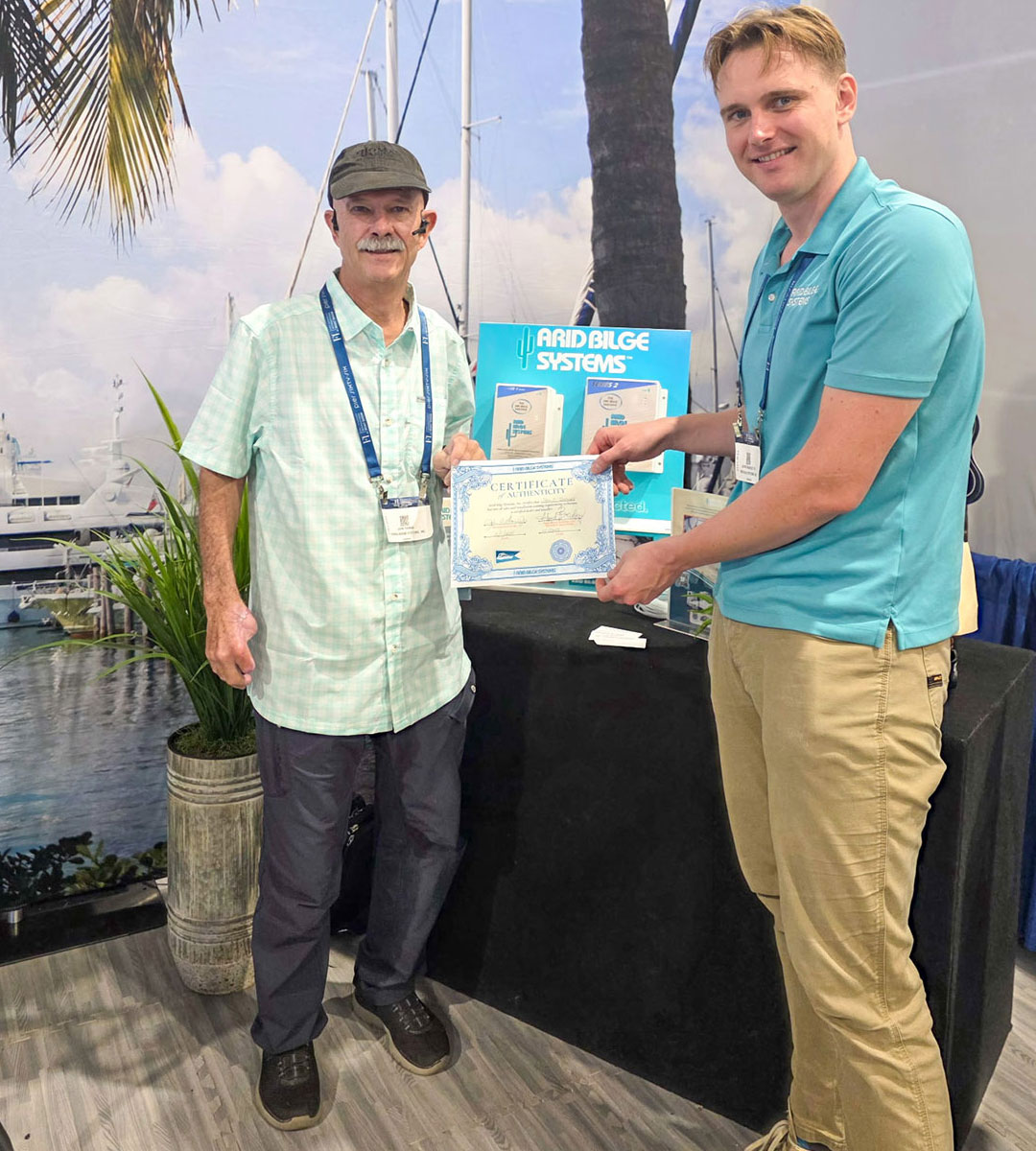
John Thomas and Alfred Baurley holding the dealer certificate, with Thomas Marine’s Arid tabletop demonstration display behind them
John Thomas and Alfred Baurley with the dealer certificate. Thomas Marine’s Arid dummy display sits on the table behind them.

Follow the Water After It Leaves the Air

A dehumidified cabin does not tell you whether a drip pan, drain or sump below it is clear. Inspect those parts as a connected path: where does condensate collect, how does it leave, and what remains after the air conditioner stops?

Record an overflow or recurring pool before choosing equipment. A blocked drain needs attention at the source. A pickup may serve a selected collection point, but it cannot reach every compartment simply because a central unit is installed.

A Focused Conversation with Thomas Marine

Bring photographs of the collection points and describe when water appears. Ask how the proposed arrangement will be inspected, cleaned and serviced. Our wet-zone guide can help organize those observations.

Residual-water removal addresses liquid water at connected pickup locations. It does not remove existing mildew, repair corrosion or replace conventional bilge pumps. Those distinctions matter when turning a general conversation about a drier boat into a specific installation plan.

Visit Thomas Marine’s Arid Bilge landing page to discuss the layout and confirm current service arrangements.

Related Boat-Builder Interviews

For additional perspectives on dry bilges, these separate Arid interviews feature:

This article is an edited overview of the Thomas Marine conversation, not a verbatim transcript. Watch the full video.

13 11, 2025
  • Tuppens Marine and Arid Bilge Systems video thumbnail.

See Arid Bilge Systems at Tuppen’s Marine

By |2026-10-13T20:12:00+00:00November 13, 2025|Articles|

See Arid Bilge Systems at Tuppen’s Marine

In this short visit, Tuppen’s Marine introduces its Arid Bilge Systems dealership and invites boaters to see the display inside the store. The conversation is a starting point for understanding residual-water removal and asking how it could fit a particular boat.

The Tuppen’s representative describes the business as serving local boating customers since 1956. Watch the visit for the team’s own introduction and invitation.

For the shorter clip, watch Tuppen’s Marine on Arid Bilge | Cleaner, Drier Bilges.

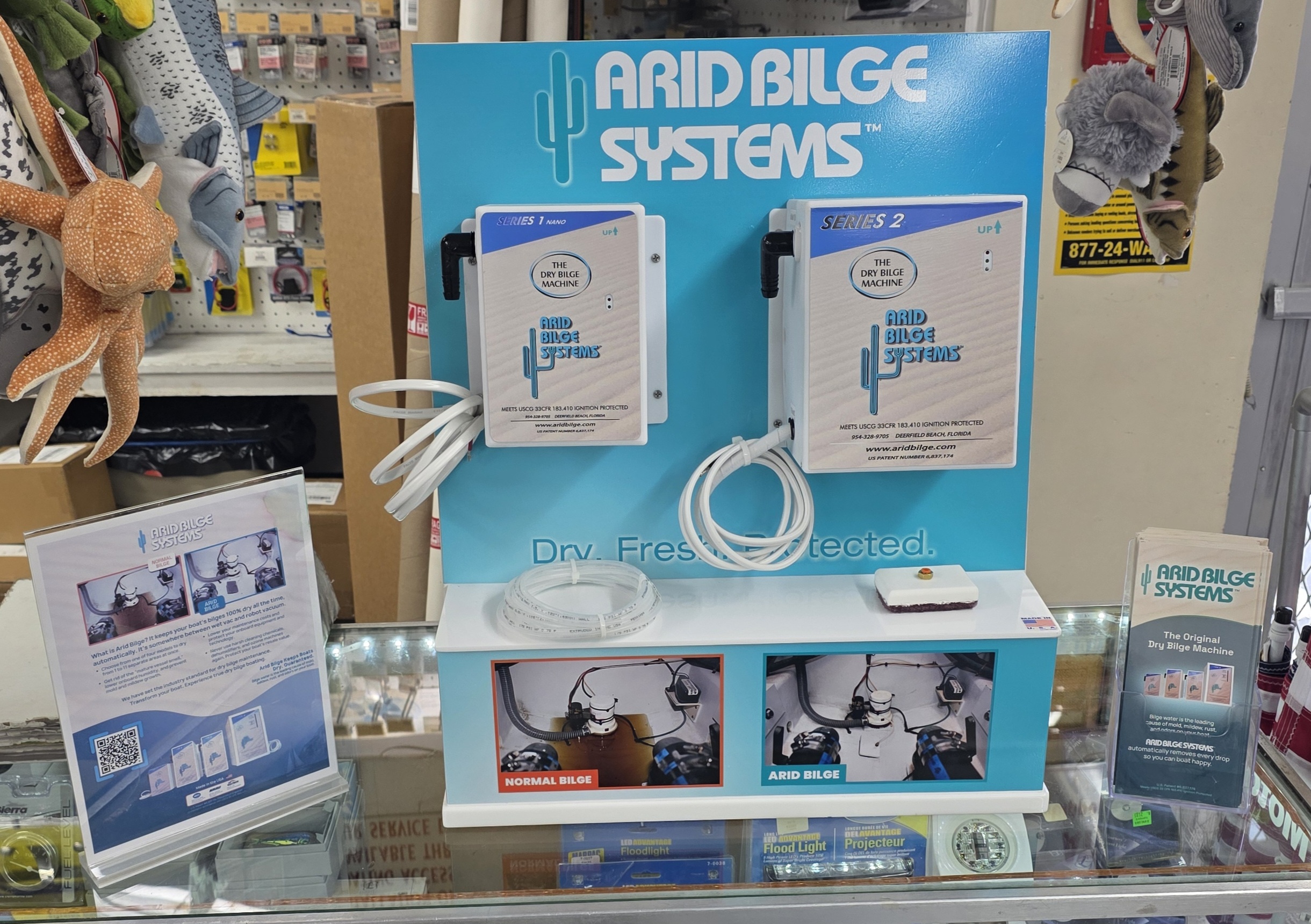
Arid Bilge Systems counter display inside Tuppen’s Marine
The Arid counter display at Tuppen’s Marine. This photograph shows an earlier display edition; contact the store to confirm the current display and available models.

Make a Visit to Tuppen’s Marine Useful

Before visiting, take photographs of the places where water remains after ordinary pumping. Include the nearby structure and access opening so the conversation can cover placement and service, not just the size of the main unit.

Ask which pickup suits each space, where tubing would run and how the owner would reach the pickup for cleaning. Visit Tuppen’s Marine’s Arid Bilge collection to confirm the current equipment on display and the installation support available. The video does not establish today’s stock or every included component.

Our bilge pickup guide explains why compartment shape and model compatibility matter. Bring that information together with your wet-zone notes when discussing a system.

Keep the Job of Each Pump Clear

Arid removes residual water from connected pickup locations. Conventional bilge pumps still handle the job for which the boat is equipped. Neither a showroom demonstration nor a dry patch establishes that a leak has been repaired or that every compartment is covered.

For a useful installation discussion, identify the water source, the collection point and the planned discharge route. Those details are more informative than choosing from boat length alone.

Related Builder Perspectives

These separate interviews show how boat builders discuss dry bilges in their own vessels:

This article is an edited overview of the Tuppen’s Marine visit, not a verbatim transcript. Watch the full video.

23 10, 2025
  • Midnight Express and Arid Bilge Systems interview thumbnail with Eric Glaser and Alfred Baurley.

Midnight Express: Eric Glaser on Arid Pickup Locations

By |2026-10-13T16:59:44+00:00October 23, 2025|Articles, Blog, Boat Builders, Boat Stories, Center Consoles, Performance Boats|

Where does the water remain after the bilge pump stops? On a boat with several separate compartments, that question needs more than one answer. Arid supplies Midnight Express, and Eric Glaser’s conversation with Alfred Baurley explains how the builder approaches collection points below deck.

Midnight Express builds performance center consoles in Miami and emphasizes customization. The interview brings that idea into an area an owner may see only through an access hatch: the placement of a central drying unit and the lines serving it.

Start with the compartments

Glaser describes mounting the central unit in the rear bilge, with pickups in the rear and mid-bilge. Depending on the customer’s needs, he says, a collection point may also be fitted near the bow thruster where water can remain.

At the time of the interview, Glaser described Arid as an option offered across the builder’s models. The conversation does not identify one particular Midnight Express model, and a buyer should confirm the equipment and pickup plan for the boat being ordered. The useful detail is the approach: choose collection points for the spaces that need them.

Make the pickup plan easy to follow

When reviewing a build or an existing installation, ask for a simple compartment map. Mark the central unit, each pickup and the access point used to inspect it. If the bow-thruster compartment is included, identify its line rather than assuming it is covered because a system is fitted elsewhere.

Then consider service access. Can someone reach the pickup to inspect it? Can the tubing route be followed without moving unrelated equipment? A short walkthrough with the installer can turn an equipment list into something the owner and service team can use.

The Phenom 34 walkthrough offers another example of why separate bilge areas deserve individual attention. The Hylas H57 conversation adds another consideration: where operating equipment sits in relation to the living space. Both are useful comparisons, rather than specifications for a Midnight Express.

See the water-routing animation

Illustrative Arid water-routing animation. Actual equipment placement and pickup locations vary by vessel and installation.

This silent animation shows pickups in separate low areas connected by tubing to a central Arid unit, with collected water moving through a discharge line.

Keep the jobs of the two systems clear

Arid addresses residual water through pickups connected to a central unit. Conventional bilge pumps retain their own job, and a new source of water still needs investigation. Our guide to how Arid works shows the collection and discharge process.

For the owner, the takeaway from Glaser’s account is concrete: understand which compartments are served, how to reach the equipment and what was specified for this boat. Those details belong in the handover as much as the controls at the helm.

For a brief introduction, watch the Midnight Express interview Short.

The Midnight Express interview

Alfred: Eric, can you tell me a little about your experience—how the Arid Bilge System has worked across your Midnight Express boats?

Eric: Yeah, absolutely. We offer Arid Bilge Systems across all of our models. It helps keep the bilges dry and clean, so you’re not worried about all the corrosion and the mess you’d normally find down there. It’s a great option. You guys have a bunch of different versions—some different power supply options—and it works for us depending on which way we’re powering the boat.

Alfred: Where is the system mounted on the boat?

Eric: We mount them in the rear bilge of the boat on every model.

Alfred: What locations does it vacuum from?

Eric: So we do one in the rear bilge, one in the mid-bilge, and then depending on what the customer asks for, sometimes we do one up by a bow thruster, where it might catch a little bit of water—just to help keep everything dry in those areas too.

Alfred: And this has improved your boats by keeping everything nice and dry versus having a wet, moldy environment—especially when you think about protecting your Seakeeper, your generator, and all the sensitive components that are down in those compartments.

Eric: Of course. It’s all good things. Water messes everything up, and we’re in a wet environment on a boat—so it just makes sense to dry it out.

Alfred: Eric, I really appreciate your time.

Eric: No problem. Thanks for making a great product. Keep it up.

Why builders choose Arid: explore the benefits for builders and owners, and read our boat-building story.

22 10, 2025
  • Arid Bilge Systems Interview with Scout Boats

Scout Boats and Arid: Josh Slayton on Dry Bilges

By |2026-10-13T16:59:44+00:00October 22, 2025|Articles, Blog, Boat Builders, Boat Stories|

The deck is clean, the bilge has been attended to, and a shallow puddle remains. Josh Slayton of Scout Boats describes that small unfinished part of the job in our interview: a conventional bilge pump can leave water at the bottom after cleaning.

Arid supplies Scout Boats. Slayton’s account, published in October 2025, makes the relationship tangible. He talks about crews responsible for cleaning below-deck areas on boats used as yacht tenders, and about an Arid installation serving two wet areas. Those details explain a use for residual-water removal without making every Scout installation identical.

Fit and finish includes the spaces you open

Scout’s own history traces the company’s beginnings through Steve Potts and his family. In the interview, Slayton connects that background with the builder’s attention to fit and finish. His example moves the conversation from how a boat looks at delivery to the work involved in keeping its compartments presentable.

That distinction matters to an owner or crew. Cleaning deals with the surfaces; a pickup serves the residual liquid that reaches it. A drying system does not remove the need to inspect the space, investigate returning water or follow the boat’s cleaning instructions.

Understand the two-area example

Slayton describes wet bilge areas containing seacocks and sea strainers. In the conversation, the collection arrangement serves the lazarette and cabin area. The useful point is that separate spaces need to be considered separately when planning the pickups.

For your boat, ask the builder or installer to identify which low points are served, where the central unit sits, and how the pickups can be reached. Confirm the arrangement for the particular model and hull. The interview’s two-area description should not be treated as a current equipment list for the entire Scout range.

Watch the original conversation with Josh Slayton, or see the short washdown explanation.

Finish the job with a clear routine

Arid removes residual fluid from connected pickup locations while the boat’s conventional bilge pumps remain operational. Our guide to how Arid works explains that division of work. Keep the installed system’s maintenance instructions with the rest of the boat’s equipment information so the person cleaning or checking the bilge knows what to inspect.

The Midnight Express interview offers another builder’s view of choosing pickup locations. Albemarle’s Keith Privott discusses finished bilges and owner care. Together, these conversations give an owner useful questions about the spaces below deck and the attention they will need over time.

Transcript: Onboard With Scout Boats

Alfred:
Josh Slayton is going to go ahead and tell us a little about his personal experience, a little bit of the company history, how they’ve been in business for so long—and you get, obviously, the high quality and keen detail on all these boats. They are sharp, they are beautiful, and they last for a long time.

We’re an American-made system, keeping that boating experience nice, fresh, and clean. Josh?

Josh:
Yeah, thanks Alfred. Appreciate the opportunity.

Scout is a family-run business. It was founded in 1989 by Steve Potts, and from then until now, it is still owned and operated by the Potts family. Whether you’re talking about Steve Potts, his son, his two daughters, his son-in-law, his other son-in-law—they’re all part of the family-run company.

Originally founded with high fit and finish, high performance, and high styling. And with the fit and finish, we really appreciate the opportunity to have partnered with Arid Bilge to help enhance that feature of the Scout boats—the fit and finish.

Alfred:
It’s not easy producing a boat, and with the Arid Bilge System, we go ahead and keep that boating experience fresh and clean, just like it came out from the box.

That’s what the Arid Bilge System does. It gets rid of your odor, it gets rid of your mold, it gets rid of your corrosion—the rust, potentially, as well. All that stuff gets sucked out at the source, as opposed to just sitting down there.

We suck it out. A bilge pump doesn’t have to run anymore—only for the emergency. That’s what the Arid Bilge System does, and that’s what the Arid Bilge System experience is. We just vacuum it up and throw it overboard.

Josh:
Right now, our largest boat in the fleet—soon to be 67′ in the fleet—both of those are wet bilges because they have seacocks and sea strainers in them.

And in both of those sections, we utilize the two-ported Arid Bilge System.

Alfred:
So the Arid Bilge System sits in the lazarette of that boat right over there, and it goes and vacuums the fluid from that zone and the cabin zone—is that correct?

Josh:
Yeah, both zones get vacuumed together into the collection box, and then discharged overboard once the collection box is full.

Alfred:
So the Arid Bilge System sits on the aft of your boat. You’ve got some expensive equipment down there. You’ve got your generator, you’ve got your gyro, and just everything in the local environment.

Josh:
Yeah, your ice machines.

Alfred:
So you like to go and see the boat having a nice, dry, clean experience—because as opposed to that water sitting down there, it’s just causing a little bit of mold.

Josh:
Oh, it’s fantastic. And particularly on our quality of boats, we get a lot of boats as tenders to yachts. The crew are responsible for cleaning the top deck, but are actually responsible for also washing and cleaning the bilge areas.

So when they do wash and clean the bilge areas, the bilge pump itself leaves a little bit of water at the bottom that it can’t suck out—but the Arid Bilge is utilized perfectly in that situation to completely dry it out.

Alfred:
Yeah. Thank you so much for your testimonial. Appreciate having business with you.

Josh:
Yeah. Thanks, Alfred.

Alfred:
Thank you.


See the water-routing animation

Illustrative Arid water-routing animation. Actual equipment placement and pickup locations vary by vessel and installation.

This silent animation shows pickups in separate low areas connected by tubing to a central Arid unit, with collected water moving through a discharge line.

Why builders choose Arid: explore the benefits for builders and owners, and read our boat-building story.

22 10, 2025
  • Arid Bilge Systems Regulator Boat Interview

Regulator Bilge Drying: Planning an Arid Installation

By |2026-11-07T00:56:59+00:00October 22, 2025|Articles, Blog, Boat Builders, Boat Stories|

A useful bilge-drying conversation starts with an open hatch. Where does water remain? Can you reach that spot? What else shares the compartment? Those questions give a Regulator owner a clearer installation brief than boat length alone.

Arid supplies Regulator Marine. The builder’s own history begins in Edenton, North Carolina, where Joan and Owen Maxwell developed the first Regulator in a former grocery store. Its account of the company’s beginnings emphasizes the testing and attention to detail behind the boat. Planning equipment below deck deserves that same close look.

Map the water before choosing the system

A conventional bilge pump can leave shallow water below its intake. Water can also settle in a separate low area that does not drain toward that pump. Arid collects residual fluid through connected pickups, so the first job is to identify the areas an installation needs to serve.

Make a simple record of what you find during normal use: the compartment, where water sits, and when you notice it. A photograph taken from the access hatch can help explain both the low point and the space available around it. Unexpected or recurring water also needs investigation; drying the compartment does not repair its source.

Make access part of the plan

Ask the installer to walk through the proposed pickup locations, central-unit position, tubing route and discharge arrangement. Then ask how each part will be reached for inspection and maintenance. The practical question is whether someone can service the installation after the surrounding equipment is in place.

A model-specific example appears in Regulator’s 2026 Regulator 37 price sheet: the optional-equipment list includes an Arid Series 2 dry-bilge system configured for 12V power and two zones in the machine room.

Confirm the current equipment specification for your particular Regulator with the builder, dealer or installer. The existing Regulator and Arid video introduces the subject; it is not a specification for every model or hull. A short version is also available.

Keep the rest of the bilge routine

Arid supplements the boat’s bilge pumps. Keep those pumps operational, follow the instructions for the installed drying system, and leave time for routine inspection. Our explanation of how Arid works follows the collection and discharge process and explains its limits.

Two other builder conversations help sharpen the questions. Scout’s Josh Slayton discusses water left after bilge cleaning, while Albemarle’s Keith Privott considers the care of finished bilges. Each describes its own boats and practices. Use those perspectives to prepare a better conversation about your Regulator’s actual layout.

Why builders choose Arid: explore the benefits for builders and owners, and read our boat-building story.

25 06, 2025
  • HCB Yachts and Arid Bilge Systems interview thumbnail with before-and-after bilge photographs.

HCB Yachts and Arid Bilge: Dalton Teeter Interview

By |2026-10-13T16:59:44+00:00June 25, 2025|Articles, Blog, Boat Builders, Boat Stories, Center Consoles|

Arid supplies HCB Yachts. Aboard the 65-foot Estrella, Dalton Teeter explains the relationship through the work people do below deck: inspecting equipment, keeping compartments in good condition and reaching the drying system for maintenance.

The boat provides a distinctive setting for that discussion. HCB’s official Estrella description lists a 65-foot length, a 16-foot beam and a walk-in machine room. The space devoted to onboard systems makes their accessibility a meaningful part of the ownership experience.

Three areas aboard the interview boat

In the interview published with our 2025 story, Teeter describes bilge-drying coverage in the aft bilge, at midship and beneath the master stateroom. He connects those separate areas to the layout of the boat, rather than describing the bilge as one uninterrupted space.

Those are the areas he identifies aboard that Estrella. They are not a universal pickup count or an installation plan for every HCB. When discussing another boat, establish which compartments drain together and which have their own low points before choosing coverage.

Service access belongs in the installation plan

Teeter repeatedly returns to serviceability. He discusses reaching the system and cleaning it after debris enters the pickup arrangement. His account describes the installation he knows; the maintenance procedure for another system should come from its own instructions.

For a buyer or captain, the useful questions are specific. Can someone reach the cabinet connections? Are the pickups accessible for inspection? Will another piece of equipment block those routes later? A walkthrough of the actual spaces is more informative than selecting equipment from the yacht’s length alone.

A separate installation from the HydraSports archive

A separate HydraSports installation feature pairs the four-outboard boat underway with a photograph of its Arid Series 2 cabinet among the equipment. They show another arrangement, not the Estrella discussed in the interview. See the original photographs together in our HydraSports post.

HydraSports center console with four outboards underway, viewed from above.
HydraSports center console from Arid’s installation photo feature.
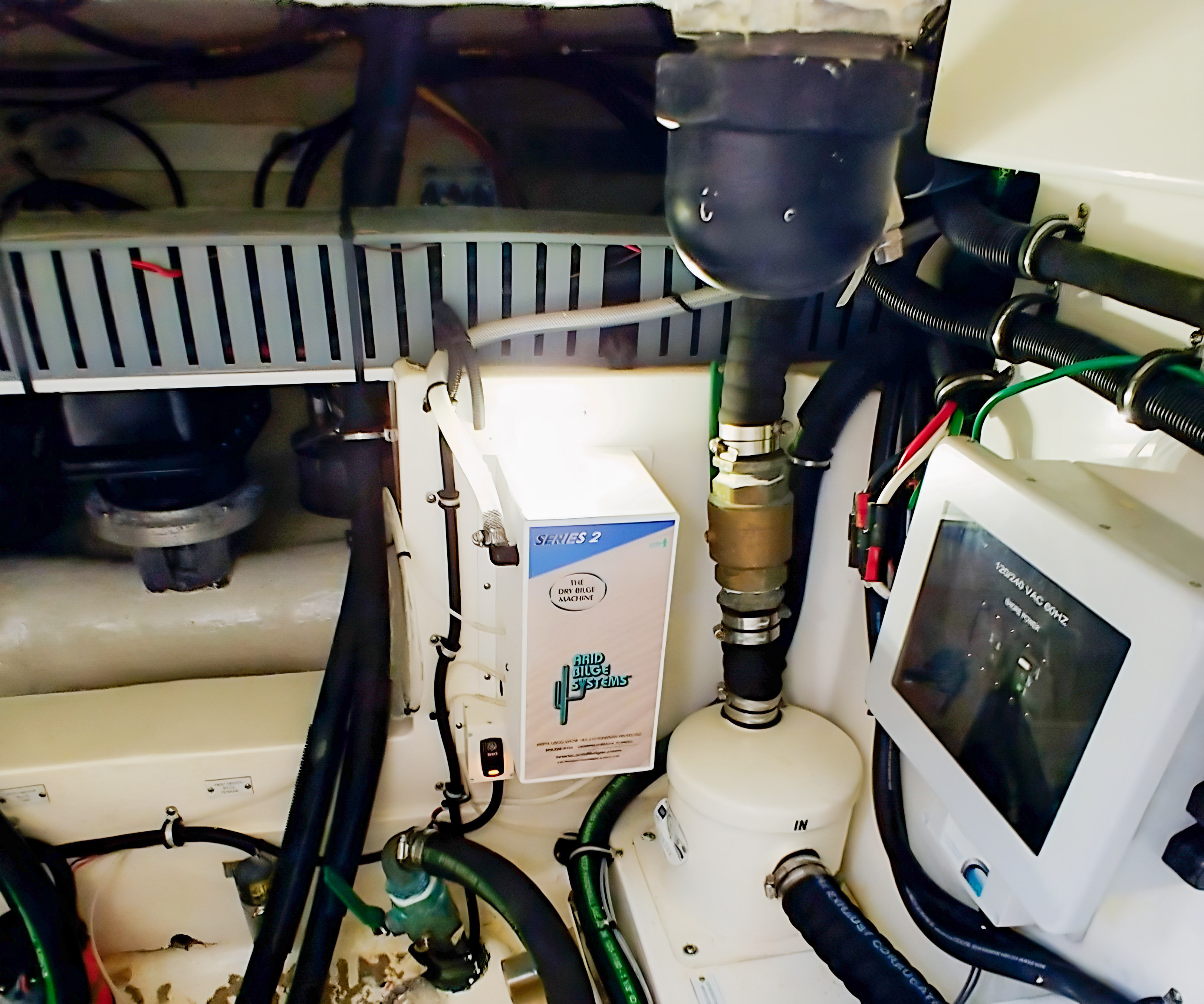
Arid Series 2 cabinet fitted beside hoses, wiring and other equipment in a HydraSports center console.
Arid Series 2 installed aboard a HydraSports center console.

Put bilge drying in the wider care routine

Arid removes residual water from connected pickup locations. It complements conventional bilge pumps; recurring water still needs investigation. The system overview explains the collection process behind those locations.

For a captain’s longer-trip perspective, continue with Everglades’ 395 interview. Bahama Boat Works’ discussion of fit and finish approaches the same equipment spaces from an owner’s first inspection. Together, the stories show different reasons to include bilge condition and maintenance access in the conversation with a builder.

See the water-routing animation

Illustrative Arid water-routing animation. Actual equipment placement and pickup locations vary by vessel and installation.

This silent animation shows pickups in separate low areas connected by tubing to a central Arid unit, with collected water moving through a discharge line.

HCB Yachts: the Estrella interview

Alfred: Hello, I’m Alfred Baurley here with Arid Bilge Systems, with Dalton at the HCB booth, and he’s going to tell us a little about the Arid Bilge System, his personal experience, and how the Arid Bilge System coexists with his line of boats.

When you take a look at these boats—these HCB boats—they build exquisite boats. They’re massive in size, and they are superbly fast. They have on this boat, Estrella, so much customization. Here at HCB, the customer will have the best boating experience possible.

At Arid Bilge Systems, we keep that boating experience dry, fresh, and clean—just like when it came out of the factory. That’s the point of the Arid Bilge System. That gyro, that generator, all these expensive marine technologies down in your bilges—all that stuff is being kept fresh and clean, as opposed to getting rust and corrosion buildup. No more mold, no more odor.

Dalton, tell me a little about your experience and what you all do here at HCB.

Dalton: First off, welcome aboard the 65′ Estrella, a center console yacht, which is truly amazing. You’re talking about the cockpit area, how wide she is. This is a 16-foot beam, which is massive. I’ve had customers put 14-foot jet boats in here as tenders.

Alfred: I mean, you’ve got a lot of poles too, I can see.

Dalton: Yeah, so funny enough, this one is a 65-foot vessel, top speed of 65, has 65 rod holders, and of course—six 600s. The ‘65 Estrella launched in 2018, and it really launched HCB into the yachting industry. We rebranded into HCB Center Console Yachts in 2018 because of this Estrella, and it put us in a new league. And to be honest, we have rocked that league, I believe.

Alfred: So would you say that the Arid Bilge System really improved your overall quality of boats?

Dalton: Yes. So the dry bilge system—we will not build a vessel without it. It’s too important for the bilge to be dry to not have it in the boat. Having a dry bilge is very important to make sure you’re not only keeping things maintained well, serviced well, and overall cleanliness.

So honestly, on the HCB, which is a high-end center console—it’s a luxury center console, right? We have to have the best of the best, our nature of the beast. We always think, we try to over-engineer things. So the Arid Bilge, for us, is a dry bilge.

A dry bilge is a happy bilge.

We have three sea chests actually in this 65, meaning fewer thru-hulls in the bottom of the boat. Everything’s going into the centralized tank system and feeding it throughout the whole vessel. So, very minimal areas to leak, but if something does get water into the bilge, that dry bilge that you all offer us keeps it a nice, dry bilge.

And it is, like you stated, in three areas: it is in the aft bilge, midship, and right underneath the master stateroom as well—just to keep everyone happy and clean. Honestly, most of the work’s always in the aft bilge pads, and it’s worked really well for us.

Alfred: Would you say that what the Arid Bilge System does—it stops the rust buildup on things like your generator and your gyro?

Dalton: It helps overall maintenance of the vessel—serviceability, things of that nature. You’re keeping the condensation out of the bilge, which is immensely important here in the marine industry. You’ve got a captain, you’ve got someone servicing your vessel—they’re really going to appreciate a dry bilge area.

If I can keep that moisture out of there, I’m going to have less service problems, as well as an overall nicer bilge area.

Alfred: Would you say that it’s a really durable system?

Dalton: I love the serviceability of the system, honestly. It’s easy to work on. It’s easy to clean. You just literally undo the hose, do some air—clean out your hoses if you’ve sucked in some dirt or debris. Because it is more of a pad on the bottom—it is sucking to the bottom of the bilge area, and you do get dirt and dust. The dry bilge system gets all that into a centralizing area, and it might get clogged.

Five minutes, quick air-clean—it’s done. That’s amazing, right? That’ll also help save our bilge pumps in the future, without getting all that dirt in our bilge pumps and having to replace bilge pumps. That Arid Bilge—you’ve pulled it in there to a central location, you’re cleaning it out—your service guys are very happy about that.

Alfred: Dalton, thank you so much for your time. This has been an amazing experience on this boat. I love all your boats, to tell you the truth. 

Dalton: I hope that we’ve educated all boaters that it is important to have a dry bilge. A dry bilge is a happy bilge.


Why builders choose Arid: explore the benefits for builders and owners, and read our boat-building story.

4 06, 2025
  • Captain Chris Zasky

Chris Zasky on Bilge Drying Aboard Divine Intervention

By |2026-10-15T02:03:02+00:00June 4, 2025|Articles, Boat Stories, Fishing Boats|

Watch the full interview


Bilge drying aboard Divine Intervention started with a source of water that was easy to overlook: condensation from the boat’s chiller pipes. Captain Chris Zasky describes why that mattered during the refit of the 77-foot Sculley sportfishing vessel.

His account covers difficult-to-reach bilges, a custom drip pan above the salon and the pickups used to collect water from those areas. He also describes an oil-alarm notification after a hydraulic hose failure. These are his experiences with the equipment and layout aboard this boat.

For the wider maintenance picture, read our guide to humidity and condensation inside a boat. It explains why removing collected water, checking its source and maintaining ventilation are separate parts of moisture control.

For a shorter look, watch Arid around the air-conditioning equipment and Captain Chris’s Arid setup. The complete walkthrough is above, with edited highlights below.


Edited highlights of Captain Chris’s walkthrough

This is an edited summary of the video, focused on the installation and the problems Zasky describes aboard Divine Intervention.

Bilge drying begins with the chiller pipes

The boat’s air-conditioning system is central to this story. Zasky explains that condensation from its chiller pipes reached compartments that were difficult to access during daily maintenance. He wanted automatic collection in those areas, alongside the cleaning, refinishing and other work undertaken during the refit.

He describes the lazarette as one example of that broader effort. Work there included new equipment, refinished surfaces and air conditioning. Arid was part of the plan for keeping residual water out of the refurbished space.

A collection point above the salon

The most distinctive pickup was fitted above the living space. According to Zasky, condensation from overhead chiller pipes had been reaching the salon lights. The team made a drip pan to catch that water and added an Arid pickup in the pan.

He reports that the area was dry when opened after the work. The useful detail is where collection began: the installation addressed water near its source instead of waiting for it to reach a lower compartment.

The central unit and companion oil equipment

In the machine room, Zasky shows the central Arid unit and the separate Eco equipment fitted to this boat. He recounts receiving an alarm after a bow-thruster hydraulic hose failed, allowing him to investigate the leak.

These functions depend on the equipment installed. The central Arid unit collects residual fluid; oil separation, contamination alerts and related shutdown functions require the appropriate companion equipment. Removing fluid alone does not make contaminated water clean.

Zasky’s walkthrough is an account of this particular refit. For another vessel, identify the wet areas, inspection access and required companion equipment before planning an installation.

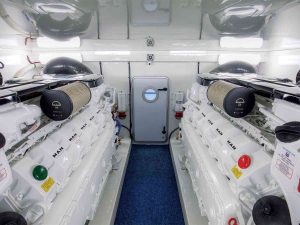
Engine room of a large boat

Illustrative engine-room photograph from the Arid archive.


Bilge drying starts with the source of the water

The overhead drip pan is a distinctive part of this refit. Zasky describes collecting condensation where it formed, then adding a pickup to remove it. The wider installation served wet areas that were difficult to reach during routine maintenance.

His story shows why the boat’s plumbing, access and water sources need to be considered together. For related care, read our discussion of bilge paint and standing water, or see how Arid collects residual fluid.

17 10, 2024
  • Chuck Casagrande of SeaSucker with Alfred Baurley aboard a catamaran, with Arid bilge comparison insets.

Chuck Casagrande on Drying His 40-Foot Catamaran

By |2026-10-15T01:37:58+00:00October 17, 2024|Articles, Boat Stories|

Chuck Casagrande’s 40-foot catamaran was an older boat rebuilt around the way he wanted to use it. The refit included custom equipment, engineering work and a less visible priority: dealing with moisture below deck.

In this boat-show interview with Alfred Baurley, the SeaSucker owner describes pickups in both hulls and the dampness he had seen around wiring and connections. He also makes an important distinction: a leaking fuel tank had to be replaced. Arid addressed the residual water that remained afterward.

A catamaran needs a survey of both hulls and the separate places where water collects. Start with our guide to finding hidden wet zones, then read how persistent dampness can contribute to corrosion below deck. Neither drying nor cleaning replaces repairs to a leaking tank or damaged equipment.

Chuck’s 40-foot catamaran refit


Alfred: Chuck Casagrande. He’s given us a testimonial review about the Arid Bilge System on his personal boat. He sells thousands of Seasuckers, and I wanna hear from him directly. What was your experience like?

Chuck: It was good. We’ve been working with you probably 4 or 5 years. And we put that system in, and that was great. It’s a big difference. I have a big boat. I have a 40-foot Catamaran. It was an older boat that we bought and we redid. And initially, we had some problems with the tank. We had moisture issues down below. It was water everywhere, even fuel for a while. Keeps it dry. We’ve got pucks in the back, and we’ve got pucks in the front. Since we have a Catamaran, you’ve got separate system on both sides. So the tubes will run over to the other pontoons forward and backwards. So it’s a pretty big system, and it works beautiful.

Alfred: First of all, you have a series 4, how many zones on that?

Chuck: But there’s, like, 4 something. I’m not technical on the actual product, but it works. It’s great.

Chuck: [At Seasucker] we’ve got a full machine shop, injection molding, tons of engineers. So I got an older boat, and we built it up from scratch, and a lot of custom stuff on there, but they really helped us fix that part of it.

Alfred: What do you mean by you have your engineers work on the boat directly?

Chuck: Well, I also have the engineers. I drag them in from Seasucker sometimes to the boat. So people laugh about a little bit. Sometimes it’s a Chuck’s boat day. Some special work on the boat together. We put a diving board on the boat. We’ve got a full de-sal system, 500 pounds of ice a day. It’s got a bathroom, sleeps 4. We’ve added all these things to it, so engineers are engaged here and there to make it work.

Alfred: Right. So did you experience any sort of humidity? That happens on Catamarans in the first place. Did you experience any odor?

Chuck: We had a ton. I mean, like I said, we had a fuel issue. So we had a big smell with the tank leaking. We had to replace the tank. But besides that, the boat still had water down there, which I didn’t like. When you have that moisture just sitting down there with all the hatches closed, you’ll see a film of moisture on all the electronics, on all the wires. Everything corrodes quicker then, so then you’re replacing stuff every year or two. With this system, everything stays dry down there. If I see it’s dry, I know my wires, my connections, everything’s gonna last a long time, and that’s what this system helps you do.


Moisture was part of the maintenance picture

Chuck’s story centers on the equipment sharing those below-deck spaces. He wanted to see less standing water and dampness around electrical connections after investing in the boat’s refit. His account describes the results on this particular installation.

For the process behind those pickups, see how Arid works.


Engine room of a large boat

Illustrative engine-room photograph from the Arid archive.


More about SeaSucker

Explore SeaSucker’s marine products and company history. This 2019 Herald-Tribune article covers its manufacturing and Florida roots. Chuck also has a LinkedIn profile.

23 08, 2024
  • Hylas Yachts and Arid Bilge Systems interview thumbnail with Kevin Wensley and Alfred Baurley.

Hylas Yachts: Kevin Wensley on Dry Bilges

By |2026-10-13T16:59:44+00:00August 23, 2024|Articles, Blog, Boat Builders, Boat Stories|

A cruising yacht is also a place to live. The cabins and salon get most of the attention, but the compartments beneath them deserve a place in the conversation. Arid supplies Hylas Yachts, and Kevin Wensley’s interview with Alfred Baurley aboard an H57 explains that relationship through the practical details of life below deck.

The Bill Dixon-designed Hylas H57 is a bluewater sailing yacht with interior customization among the builder’s priorities. For an owner planning extended time aboard, the equipment behind that interior matters alongside the layout itself: where it operates, which spaces it serves and how it can be maintained.

Small amounts of water still need a plan

Wensley gives a specific example from commissioning: rain entered while the mast was being stepped. He says the compartment was dry when he checked it before the interview. He also discusses water returning through bilge-pump plumbing after a pump stops. These are observations about the yacht and installation being discussed, rather than a promise that water can never enter a Hylas.

Arid’s role is to remove residual water alongside the yacht’s conventional bilge pumps. The collection and discharge cycle explains how low-point pickups serve a central unit. Investigating a new leak and caring for existing pumps remain part of owning the boat.

Fit the equipment around the living space

On the installation Wensley describes, the central unit sits in the insulated engine compartment. He explains that this keeps operating noise away from the living area. Collection points serve the main bilge below the salon and an aft area near the steering equipment.

That is useful information to carry into a handover. Ask to see each pickup, follow its tubing route and identify the access needed for cleaning and service. Keep that map with the installed model’s manual. It gives the next person caring for the yacht something more useful than a general instruction to check the bilge.

See the water-routing animation

Illustrative Arid water-routing animation. Actual equipment placement and pickup locations vary by vessel and installation.

This silent animation shows pickups in separate low areas connected by tubing to a central Arid unit, with collected water moving through a discharge line.

Carry the layout into the ownership conversation

Before agreeing an installation, walk through the boat with the people who will maintain it. Can the unit be reached without dismantling unrelated fittings? Which floor panels reveal the collection points? Where will electrical specifications and service instructions be kept?

The boats differ, but the placement question also appears in our Midnight Express conversation with Eric Glaser. Our Albemarle conversation with Keith Privott considers the care given to finished bilge spaces. On the H57, Wensley makes the placement question personal: the machinery has to work within a yacht that people sail, clean and live aboard.

Edited interview highlights from Hylas Yachts

This summary draws on the conversation aboard the H57. Watch the video above for the complete interview.

The small amount a bilge pump leaves behind

Wensley describes a yacht designed to stay dry, while acknowledging that some water still reaches the bilge. His example is rain entering while the mast was being stepped during commissioning. When he checked the compartment before the interview, he found it dry.

The discussion also covers water that can return from bilge-pump plumbing after a pump stops. For Wensley, removing that residual water is part of keeping the spaces below deck pleasant to use. He connects the condition of those compartments with the smell and overall feel of the yacht.

Place equipment around the way people live aboard

On this installation, the central Arid unit sits in the insulated engine compartment. Wensley explains that the placement keeps operating noise away from the living space. He describes pickups serving the main bilge beneath the salon and an aft area near the steering equipment.

Those details make the installation concrete: a central unit needs a suitable location, and the collection points need to reach the areas where water remains. Access for inspection and service belongs in that planning, too.

Installation support and electrical planning

Wensley speaks positively about communication between Arid, the Hylas factory and the service team. He describes support with installation details and questions from owners, alongside the wider service relationship Hylas maintains with its customers.

The conversation also touches on electrical demand and the resources available aboard a sailing yacht. Those comments concern the equipment discussed in this interview. Use the manual for the installed model when checking current electrical specifications and maintenance requirements.

The recurring point is comfort backed by practical details: where water collects, where equipment is fitted and how the people caring for the yacht can reach it.

Why builders choose Arid: explore the benefits for builders and owners, and read our boat-building story.

13 06, 2024
  • Alfred Baurley and Keith Privott with Albemarle boat and bilge comparison images.

Albemarle Boats: Keith Privott on Bilge Fit and Finish

By |2026-10-13T16:59:44+00:00June 13, 2024|Articles, Blog, Boat Builders, Boat Stories|

Keith Privott’s description of a finished bilge is easy to picture: open the engine-room hatch and find clean, bright surfaces, with the equipment and workmanship on view. Standing water becomes conspicuous in a space built to look that way.

Arid supplies Albemarle Boats. In our interview published in June 2024, Privott discusses Arid as one component in the builder’s broader approach to materials, finish and owner maintenance. His perspective is particularly useful for someone who enjoys looking after a boat and wants to understand the systems beneath its polished exterior.

A finished bilge needs ongoing care

Albemarle’s official history records its incorporation in 1978 and its roots in Edenton, North Carolina. Privott brings that boatbuilding story down to practical details. He describes owners who take pride in maintenance and explains how water left on a finished, gel-coated bilge can affect its appearance.

His observations are an argument for paying attention to the compartment after delivery. A good finish gives an owner something worth caring for; inspection and routine maintenance continue throughout ownership.

Where residual-water removal fits

A conventional bilge pump may leave shallow water below its intake, and separate low points may not drain to the pump. Arid collects residual fluid from the areas served by its pickups. That is a specific job within the boat’s maintenance routine.

It does not replace the conventional bilge pumps or fix a leak. If water returns, investigate the cause. If a stain remains after the compartment dries, assess the surface and follow the builder’s care guidance. Removing water and restoring an existing finish are different tasks.

Our guide to how Arid works explains the collection process. The water-routing animation illustrates the process; actual equipment placement depends on the boat.

Questions to bring to the boat

Ask which low points an installation will serve and whether the pickups are accessible for maintenance. Check that the central unit and its connections can be reached without turning a routine inspection into a major dismantling job. Confirm current equipment availability for your particular Albemarle with the builder or dealer.

Watch the original Keith Privott interview for his full account, or watch the short version. His comments describe the builder’s approach at the time of that conversation.

For a crew’s perspective on water left after cleaning, read Scout’s conversation with Josh Slayton. For a practical look at collection-point placement, see Eric Glaser’s Midnight Express interview. These are different boats, but both conversations make the below-deck questions easier to ask.

Albemarle Boats: Keith Privott’s interview

Alfred: Albemarle has been around for many years, and they produce the highest possible quality of boats, highest possible quality finish, and they want to see their boats last. That’s where the Arid Bilge System delivers that clean, dry, fresh boating experience. Keith, you mind telling us a little about that?

Keith: Yeah, like you said, it’s from the maintenance standpoint, for the longevity of the boat, we try to use the top quality materials in the boat. Everything from even hardware: instead of using a typical 316 stainless, we’ll use chrome-plated stainless where possible. So, you’re always trying to upgrade materials and use the best quality, and part of that is to keep that boat looking as good and functioning as well.

Alfred: Albemarle has been around for how long now?

Keith: Forty-five years.

Alfred: All right. Tell me a little bit about your boats.

Keith: So, we are primarily offshore fishing boats. We do build some smaller dual consoles, but our customer focus tends to be more on the hardcore fishing guys. We have typically a little bit heavier construction. We like to think we pay a lot more attention to detail and just a little bit more refined boat.

And that’s how your system comes into play as far as what we offer. We have customers that really pride themselves on maintaining boats, and a lot of those customers do the maintenance themselves. It’s just a labor of love for them to tinker around on a boat and keep it clean and upgrade everything they can.

Alfred: You would say that the Arid Bilge System really helped improve your line of boats?

Keith: I’d say so. I mean, it’s one of those systems that you don’t have to think about it. As a builder, you like systems that you can put in, and if you don’t hear back from them, that means it’s functioning correctly, and it’s not an issue. We use so many components on the boat. We deal with thousands of vendors and at the same time, we try to get the best quality you can get. The idea is to offer an experience where they don’t have to worry about replacing components or fixing. They can enjoy the boat instead of working on the boat. But also just the appearance and the odor, I mean, it just plays into everything we’re trying to do and offer better boating experience–less hassle, and more enjoyment out of the boat that they’re paying us to build.

Alfred: So one of the point with the Arid Bilge System is, we go in and make everything completely bone dry, and when it’s a dry and clean environment, it’s a happy environment in your boat. So you would say that it coexists very well in that sort of fashion for you?

Keith: Absolutely. We do finished bilges, obviously. It’s almost like it’s going to a next level over the last 20 years in particular, where it’s not the utilitarian, “let’s go out there and just fish and hammer the fish every day and come back and wash the boat down.” It’s like everything’s become more refined, and the expectations now are that you open an engine room and you’re almost dazzled by how everything is just so clean and white and well appointed. So we’ve really gone down that route, particularly in the last ten years, to pay more attention to the level of fit and finish, even down in the bilges. So when you open an engine room, everything’s nice and clean and bright, and you look down, and you don’t see puddles of water in the bilge, you don’t have any stain. We finish the bilges. A finished gel-coated bilge, if you let water sit there for weeks at a time, you start to see a little staining here and there.

Overall, it just keeps the appearance of the boat up. It keeps the maintenance at a minimum. It’s kind of a no-brainer for us to put the system on the boat. Like I said, the boats are becoming more and more refined. The systems are becoming more complicated. Everything’s becoming integrated now, so we have to grow with the business and with the technology. But at the same time, the core principles are still there of “build it stronger than it needs to be, build it for the worst-case scenario, and hope for the best.” And at the end of the day, regardless of what kind of conditions you get caught in, you’re going to come home with the same boat structurally and aesthetically. It’s going to hold up over time. And we do that by the techniques we use, building more glass than we should. Our boats are typically heavier than most, and that’s because of the materials we use. We’ve learned the construction techniques over the years, glassing everything back together and creating almost like a unibody construction where nothing moves unless everything moves. Through experience, we’ve figured out what holds up on a terrible day offshore, and we build them for that scenario.

Fast forward to today, and our largest boat is 53′  while our smallest is 25′. We have a pretty broad range of product, but it’s all dedicated to being offshore-capable, holding up over time, and being the same boat even in 20 years that it was the day it was built as long as it’s maintained and taken care of.

Alfred: Thank you so much, Keith, for giving us a short testimonial and talking about your boats. It’s been an honor, and thank you so much for the business, and I appreciate working with you.

Keith: Sure. Thank you for providing a good product. It contributes to ours.

See the water-routing animation

Illustrative Arid water-routing animation. Actual equipment placement and pickup locations vary by vessel and installation.

This silent animation shows pickups in separate low areas connected by tubing to a central Arid unit, with collected water moving through a discharge line.

Why builders choose Arid: explore the benefits for builders and owners, and read our boat-building story.