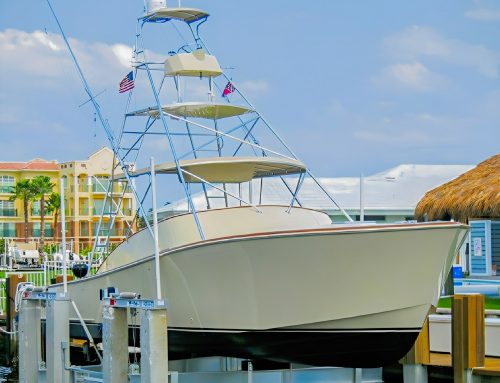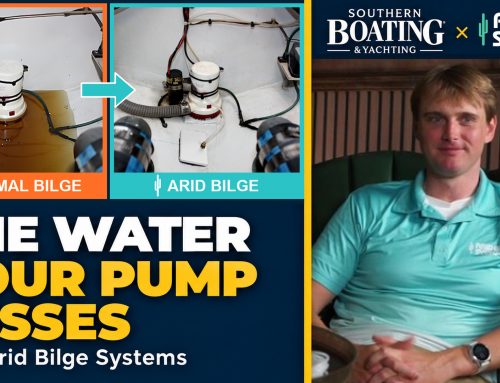

The deck is clean, the bilge has been attended to, and a shallow puddle remains. Josh Slayton of Scout Boats describes that small unfinished part of the job in our interview: a conventional bilge pump can leave water at the bottom after cleaning.
Arid supplies Scout Boats. Slayton’s account, published in October 2025, makes the relationship tangible. He talks about crews responsible for cleaning below-deck areas on boats used as yacht tenders, and about an Arid installation serving two wet areas. Those details explain a use for residual-water removal without making every Scout installation identical.
Fit and finish includes the spaces you open
Scout’s own history traces the company’s beginnings through Steve Potts and his family. In the interview, Slayton connects that background with the builder’s attention to fit and finish. His example moves the conversation from how a boat looks at delivery to the work involved in keeping its compartments presentable.
That distinction matters to an owner or crew. Cleaning deals with the surfaces; a pickup serves the residual liquid that reaches it. A drying system does not remove the need to inspect the space, investigate returning water or follow the boat’s cleaning instructions.
Understand the two-area example
Slayton describes wet bilge areas containing seacocks and sea strainers. In the conversation, the collection arrangement serves the lazarette and cabin area. The useful point is that separate spaces need to be considered separately when planning the pickups.
For your boat, ask the builder or installer to identify which low points are served, where the central unit sits, and how the pickups can be reached. Confirm the arrangement for the particular model and hull. The interview’s two-area description should not be treated as a current equipment list for the entire Scout range.
Watch the original conversation with Josh Slayton, or see the short washdown explanation.
Finish the job with a clear routine
Arid removes residual fluid from connected pickup locations while the boat’s conventional bilge pumps remain operational. Our guide to how Arid works explains that division of work. Keep the installed system’s maintenance instructions with the rest of the boat’s equipment information so the person cleaning or checking the bilge knows what to inspect.
The Midnight Express interview offers another builder’s view of choosing pickup locations. Albemarle’s Keith Privott discusses finished bilges and owner care. Together, these conversations give an owner useful questions about the spaces below deck and the attention they will need over time.
Transcript: Onboard With Scout Boats
Alfred:
Josh Slayton is going to go ahead and tell us a little about his personal experience, a little bit of the company history, how they’ve been in business for so long—and you get, obviously, the high quality and keen detail on all these boats. They are sharp, they are beautiful, and they last for a long time.
We’re an American-made system, keeping that boating experience nice, fresh, and clean. Josh?
Josh:
Yeah, thanks Alfred. Appreciate the opportunity.
Scout is a family-run business. It was founded in 1989 by Steve Potts, and from then until now, it is still owned and operated by the Potts family. Whether you’re talking about Steve Potts, his son, his two daughters, his son-in-law, his other son-in-law—they’re all part of the family-run company.
Originally founded with high fit and finish, high performance, and high styling. And with the fit and finish, we really appreciate the opportunity to have partnered with Arid Bilge to help enhance that feature of the Scout boats—the fit and finish.
Alfred:
It’s not easy producing a boat, and with the Arid Bilge System, we go ahead and keep that boating experience fresh and clean, just like it came out from the box.
That’s what the Arid Bilge System does. It gets rid of your odor, it gets rid of your mold, it gets rid of your corrosion—the rust, potentially, as well. All that stuff gets sucked out at the source, as opposed to just sitting down there.
We suck it out. A bilge pump doesn’t have to run anymore—only for the emergency. That’s what the Arid Bilge System does, and that’s what the Arid Bilge System experience is. We just vacuum it up and throw it overboard.
Josh:
Right now, our largest boat in the fleet—soon to be 67′ in the fleet—both of those are wet bilges because they have seacocks and sea strainers in them.
And in both of those sections, we utilize the two-ported Arid Bilge System.
Alfred:
So the Arid Bilge System sits in the lazarette of that boat right over there, and it goes and vacuums the fluid from that zone and the cabin zone—is that correct?
Josh:
Yeah, both zones get vacuumed together into the collection box, and then discharged overboard once the collection box is full.
Alfred:
So the Arid Bilge System sits on the aft of your boat. You’ve got some expensive equipment down there. You’ve got your generator, you’ve got your gyro, and just everything in the local environment.
Josh:
Yeah, your ice machines.
Alfred:
So you like to go and see the boat having a nice, dry, clean experience—because as opposed to that water sitting down there, it’s just causing a little bit of mold.
Josh:
Oh, it’s fantastic. And particularly on our quality of boats, we get a lot of boats as tenders to yachts. The crew are responsible for cleaning the top deck, but are actually responsible for also washing and cleaning the bilge areas.
So when they do wash and clean the bilge areas, the bilge pump itself leaves a little bit of water at the bottom that it can’t suck out—but the Arid Bilge is utilized perfectly in that situation to completely dry it out.
Alfred:
Yeah. Thank you so much for your testimonial. Appreciate having business with you.
Josh:
Yeah. Thanks, Alfred.
Alfred:
Thank you.
See the water-routing animation
This silent animation shows pickups in separate low areas connected by tubing to a central Arid unit, with collected water moving through a discharge line.
Why builders choose Arid: explore the benefits for builders and owners, and read our boat-building story.