HCB Yachts and Arid Bilge: Dalton Teeter Interview
Arid supplies HCB Yachts. Aboard the 65-foot Estrella, Dalton Teeter explains the relationship through the work people do below deck: inspecting equipment, keeping compartments in good condition and reaching the drying system for maintenance.
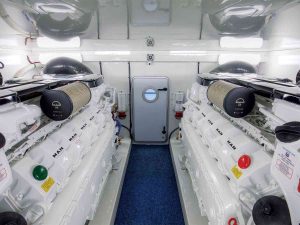
The boat provides a distinctive setting for that discussion. HCB’s official Estrella description lists a 65-foot length, a 16-foot beam and a walk-in machine room. The space devoted to onboard systems makes their accessibility a meaningful part of the ownership experience.
Three areas aboard the interview boat
In the interview published with our 2025 story, Teeter describes bilge-drying coverage in the aft bilge, at midship and beneath the master stateroom. He connects those separate areas to the layout of the boat, rather than describing the bilge as one uninterrupted space.
Those are the areas he identifies aboard that Estrella. They are not a universal pickup count or an installation plan for every HCB. When discussing another boat, establish which compartments drain together and which have their own low points before choosing coverage.
Service access belongs in the installation plan
Teeter repeatedly returns to serviceability. He discusses reaching the system and cleaning it after debris enters the pickup arrangement. His account describes the installation he knows; the maintenance procedure for another system should come from its own instructions.
For a buyer or captain, the useful questions are specific. Can someone reach the cabinet connections? Are the pickups accessible for inspection? Will another piece of equipment block those routes later? A walkthrough of the actual spaces is more informative than selecting equipment from the yacht’s length alone.
A separate installation from the HydraSports archive
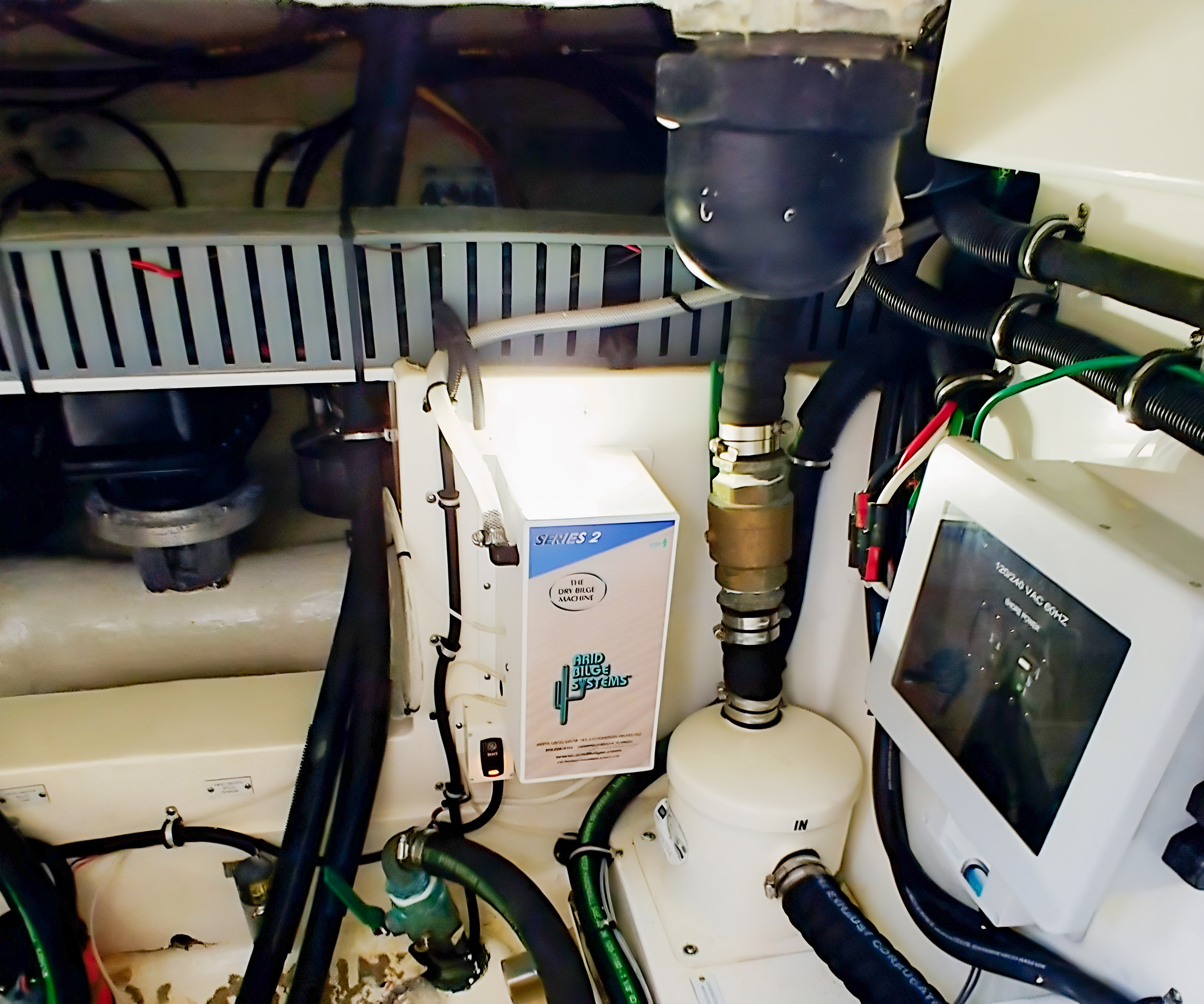
A separate HydraSports installation feature pairs the four-outboard boat underway with a photograph of its Arid Series 2 cabinet among the equipment. They show another arrangement, not the Estrella discussed in the interview. See the original photographs together in our HydraSports post.

Put bilge drying in the wider care routine
Arid removes residual water from connected pickup locations. It complements conventional bilge pumps; recurring water still needs investigation. The system overview explains the collection process behind those locations.
For a captain’s longer-trip perspective, continue with Everglades’ 395 interview. Bahama Boat Works’ discussion of fit and finish approaches the same equipment spaces from an owner’s first inspection. Together, the stories show different reasons to include bilge condition and maintenance access in the conversation with a builder.
See the water-routing animation
This silent animation shows pickups in separate low areas connected by tubing to a central Arid unit, with collected water moving through a discharge line.
HCB Yachts: the Estrella interview
Alfred: Hello, I’m Alfred Baurley here with Arid Bilge Systems, with Dalton at the HCB booth, and he’s going to tell us a little about the Arid Bilge System, his personal experience, and how the Arid Bilge System coexists with his line of boats.
When you take a look at these boats—these HCB boats—they build exquisite boats. They’re massive in size, and they are superbly fast. They have on this boat, Estrella, so much customization. Here at HCB, the customer will have the best boating experience possible.
At Arid Bilge Systems, we keep that boating experience dry, fresh, and clean—just like when it came out of the factory. That’s the point of the Arid Bilge System. That gyro, that generator, all these expensive marine technologies down in your bilges—all that stuff is being kept fresh and clean, as opposed to getting rust and corrosion buildup. No more mold, no more odor.
Dalton, tell me a little about your experience and what you all do here at HCB.
Dalton: First off, welcome aboard the 65′ Estrella, a center console yacht, which is truly amazing. You’re talking about the cockpit area, how wide she is. This is a 16-foot beam, which is massive. I’ve had customers put 14-foot jet boats in here as tenders.
Alfred: I mean, you’ve got a lot of poles too, I can see.
Dalton: Yeah, so funny enough, this one is a 65-foot vessel, top speed of 65, has 65 rod holders, and of course—six 600s. The ‘65 Estrella launched in 2018, and it really launched HCB into the yachting industry. We rebranded into HCB Center Console Yachts in 2018 because of this Estrella, and it put us in a new league. And to be honest, we have rocked that league, I believe.
Alfred: So would you say that the Arid Bilge System really improved your overall quality of boats?
Dalton: Yes. So the dry bilge system—we will not build a vessel without it. It’s too important for the bilge to be dry to not have it in the boat. Having a dry bilge is very important to make sure you’re not only keeping things maintained well, serviced well, and overall cleanliness.
So honestly, on the HCB, which is a high-end center console—it’s a luxury center console, right? We have to have the best of the best, our nature of the beast. We always think, we try to over-engineer things. So the Arid Bilge, for us, is a dry bilge.
A dry bilge is a happy bilge.
We have three sea chests actually in this 65, meaning fewer thru-hulls in the bottom of the boat. Everything’s going into the centralized tank system and feeding it throughout the whole vessel. So, very minimal areas to leak, but if something does get water into the bilge, that dry bilge that you all offer us keeps it a nice, dry bilge.
And it is, like you stated, in three areas: it is in the aft bilge, midship, and right underneath the master stateroom as well—just to keep everyone happy and clean. Honestly, most of the work’s always in the aft bilge pads, and it’s worked really well for us.
Alfred: Would you say that what the Arid Bilge System does—it stops the rust buildup on things like your generator and your gyro?
Dalton: It helps overall maintenance of the vessel—serviceability, things of that nature. You’re keeping the condensation out of the bilge, which is immensely important here in the marine industry. You’ve got a captain, you’ve got someone servicing your vessel—they’re really going to appreciate a dry bilge area.
If I can keep that moisture out of there, I’m going to have less service problems, as well as an overall nicer bilge area.
Alfred: Would you say that it’s a really durable system?
Dalton: I love the serviceability of the system, honestly. It’s easy to work on. It’s easy to clean. You just literally undo the hose, do some air—clean out your hoses if you’ve sucked in some dirt or debris. Because it is more of a pad on the bottom—it is sucking to the bottom of the bilge area, and you do get dirt and dust. The dry bilge system gets all that into a centralizing area, and it might get clogged.
Five minutes, quick air-clean—it’s done. That’s amazing, right? That’ll also help save our bilge pumps in the future, without getting all that dirt in our bilge pumps and having to replace bilge pumps. That Arid Bilge—you’ve pulled it in there to a central location, you’re cleaning it out—your service guys are very happy about that.
Alfred: Dalton, thank you so much for your time. This has been an amazing experience on this boat. I love all your boats, to tell you the truth.
Dalton: I hope that we’ve educated all boaters that it is important to have a dry bilge. A dry bilge is a happy bilge.
Why builders choose Arid: explore the benefits for builders and owners, and read our boat-building story.