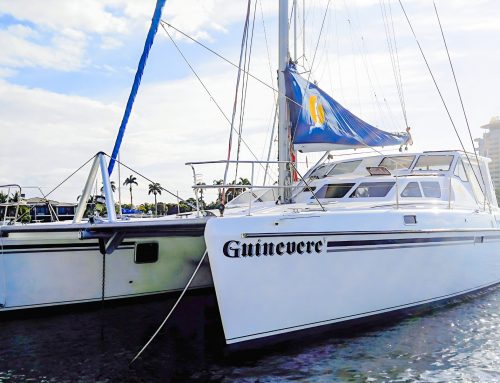

Chuck Casagrande’s 40-foot catamaran was an older boat rebuilt around the way he wanted to use it. The refit included custom equipment, engineering work and a less visible priority: dealing with moisture below deck.
In this boat-show interview with Alfred Baurley, the SeaSucker owner describes pickups in both hulls and the dampness he had seen around wiring and connections. He also makes an important distinction: a leaking fuel tank had to be replaced. Arid addressed the residual water that remained afterward.
A catamaran needs a survey of both hulls and the separate places where water collects. Start with our guide to finding hidden wet zones, then read how persistent dampness can contribute to corrosion below deck. Neither drying nor cleaning replaces repairs to a leaking tank or damaged equipment.
Chuck’s 40-foot catamaran refit
Alfred: Chuck Casagrande. He’s given us a testimonial review about the Arid Bilge System on his personal boat. He sells thousands of Seasuckers, and I wanna hear from him directly. What was your experience like?
Chuck: It was good. We’ve been working with you probably 4 or 5 years. And we put that system in, and that was great. It’s a big difference. I have a big boat. I have a 40-foot Catamaran. It was an older boat that we bought and we redid. And initially, we had some problems with the tank. We had moisture issues down below. It was water everywhere, even fuel for a while. Keeps it dry. We’ve got pucks in the back, and we’ve got pucks in the front. Since we have a Catamaran, you’ve got separate system on both sides. So the tubes will run over to the other pontoons forward and backwards. So it’s a pretty big system, and it works beautiful.
Alfred: First of all, you have a series 4, how many zones on that?
Chuck: But there’s, like, 4 something. I’m not technical on the actual product, but it works. It’s great.
Chuck: [At Seasucker] we’ve got a full machine shop, injection molding, tons of engineers. So I got an older boat, and we built it up from scratch, and a lot of custom stuff on there, but they really helped us fix that part of it.
Alfred: What do you mean by you have your engineers work on the boat directly?
Chuck: Well, I also have the engineers. I drag them in from Seasucker sometimes to the boat. So people laugh about a little bit. Sometimes it’s a Chuck’s boat day. Some special work on the boat together. We put a diving board on the boat. We’ve got a full de-sal system, 500 pounds of ice a day. It’s got a bathroom, sleeps 4. We’ve added all these things to it, so engineers are engaged here and there to make it work.
Alfred: Right. So did you experience any sort of humidity? That happens on Catamarans in the first place. Did you experience any odor?
Chuck: We had a ton. I mean, like I said, we had a fuel issue. So we had a big smell with the tank leaking. We had to replace the tank. But besides that, the boat still had water down there, which I didn’t like. When you have that moisture just sitting down there with all the hatches closed, you’ll see a film of moisture on all the electronics, on all the wires. Everything corrodes quicker then, so then you’re replacing stuff every year or two. With this system, everything stays dry down there. If I see it’s dry, I know my wires, my connections, everything’s gonna last a long time, and that’s what this system helps you do.
Moisture was part of the maintenance picture
Chuck’s story centers on the equipment sharing those below-deck spaces. He wanted to see less standing water and dampness around electrical connections after investing in the boat’s refit. His account describes the results on this particular installation.
For the process behind those pickups, see how Arid works.
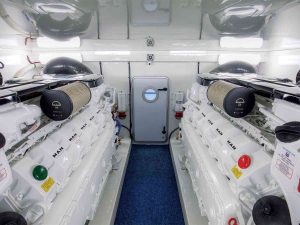
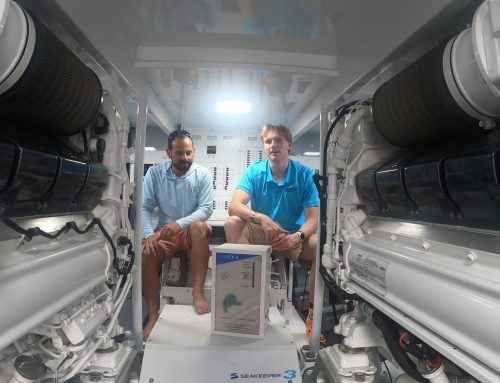
Illustrative engine-room photograph from the Arid archive.
More about SeaSucker
Explore SeaSucker’s marine products and company history. This 2019 Herald-Tribune article covers its manufacturing and Florida roots. Chuck also has a LinkedIn profile.