Keeping owners satisfied after the boat leaves the factory
Why do builders choose Arid? Because the water left below a conventional bilge pump's pickup deserves a plan of its own. A drier low point can make inspection easier and removes one source of persistent moisture. For builders, dealers and owners, the longer-term value depends on the boat, the installation and the service work actually avoided.
Dealers and service departments often see the long-term consequences of below-deck moisture before anyone else.
They sell the boat, maintain it, communicate with the owner, and see what returns months or years later: odor complaints, corrosion, damp compartments, electrical concerns, generator problems, gyro issues, thruster service, and components that appear to have aged prematurely.
That does not mean builders have overlooked the problem. Boat builders already face the difficult responsibility of engineering complex vessels, improving layouts, controlling production costs, meeting safety requirements, and delivering greater value to the customer.
The challenge is that residual moisture often creates problems gradually—and the eventual failure may not be traced back to the environment that contributed to it.
How Below-Deck Moisture Can Become a Warranty Concern
Moisture-related problems may return to a builder through:
- Warranty claims
- Dealer service reports
- Component replacement costs
- Corrosion and electrical diagnostics
- Customer complaints
- Odor and mildew concerns
- Reduced long-term owner satisfaction
A generator, gyro, thruster, pump, bracket, fastener, or wiring connection may require service during the warranty period. In many cases, the visible component failure receives attention while the damp environment surrounding that component goes unaddressed.
Repairing the component addresses the immediate failure. Investigating recurring water addresses an environmental condition that may otherwise remain after the repair.
Two Ways Moisture Reaches Marine Equipment
Moisture generally affects below-deck equipment through two primary pathways.
Direct exposure
Equipment mounted low in a vessel may be exposed to standing water, splash, or fluid moving between compartments.
Depending on the vessel layout, this may affect:
- Pumps and float switches
- Wiring connections
- Fasteners and brackets
- Thruster equipment
- Generators
- Sensors and control components
We have observed situations where water moved aft through the vessel and reached equipment mounted in machinery spaces.
Environmental exposure
Equipment does not have to sit in water to be exposed to moisture. Residual water can evaporate as an enclosed compartment warms, then condense on cooler surfaces.
With limited ventilation, that cycle can keep wiring, fasteners and surrounding machinery damp. Over time, it can contribute to odor, mildew, corrosion and staining. Our guide to bilge odor, humidity and corrosion explains the moisture pathways and inspection checks behind those concerns.
What happens out of sight, below deck?
A small pool can keep supplying water vapor as a compartment warms. When a surface is below the dew point, moisture can condense there. Standing water can also reach low-mounted equipment directly. Persistent dampness, organic residues and limited ventilation can contribute to mildew, odors and corrosion.
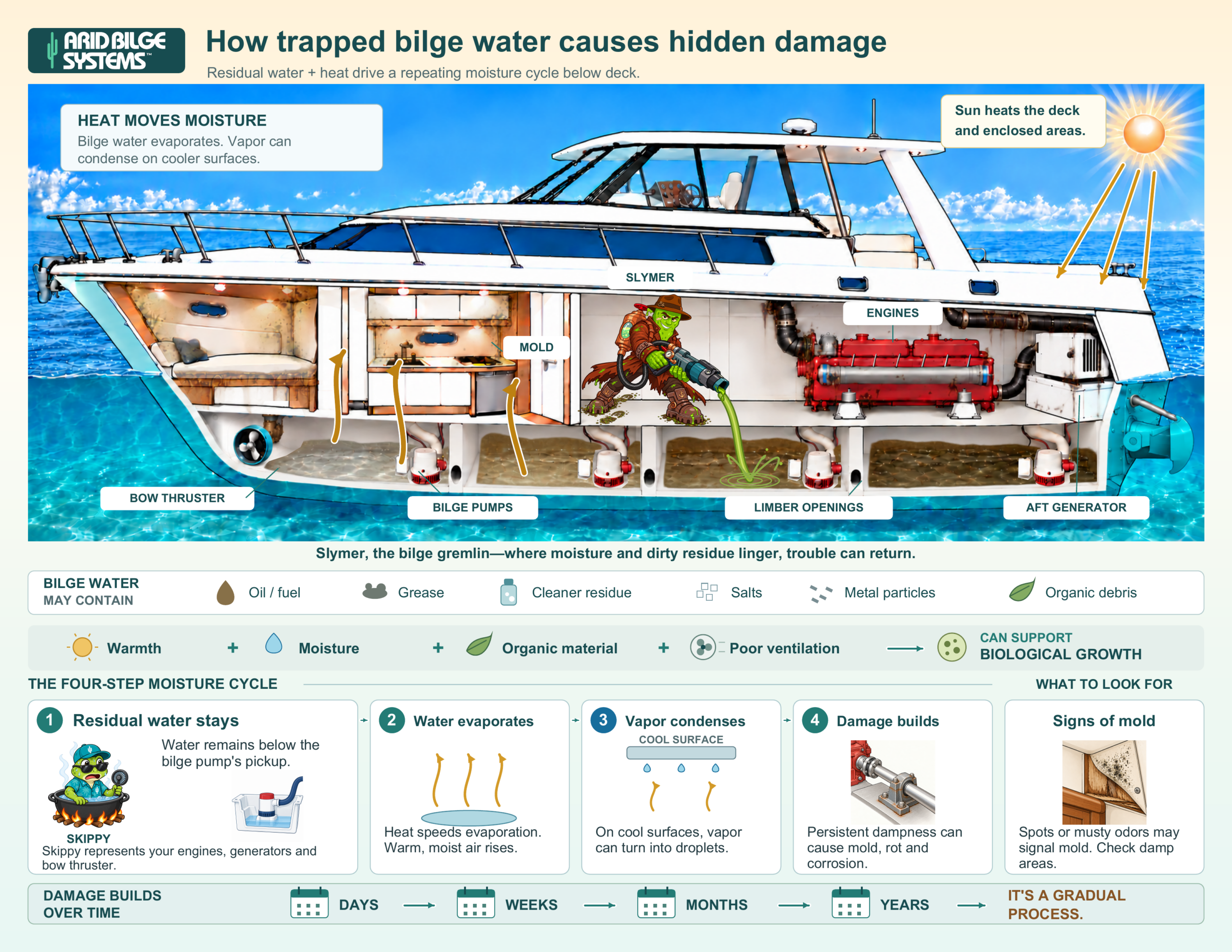
The service question is both what failed? and why was this area wet? A repair may restore a connection or component while a leaking fitting, blocked drainage route or wet low point remains. Diagnosing the actual cause matters: not every electrical, generator or thruster problem is caused by bilge water.
What Same-Model Comparisons Can Reveal
Inspecting similar vessels over time can help a builder identify recurring wet areas and service concerns. Record standing water, staining, odors and the condition of surrounding equipment, alongside installation and maintenance differences.
Those observations can guide investigation. They do not, by themselves, isolate the effect of Arid or establish a measured reduction in repairs.
These observations do not mean every component problem is caused by bilge water. Equipment life is influenced by installation quality, climate, operating conditions, ventilation, maintenance, salt exposure, and many other variables.
However, the underlying physics remains straightforward:
When residual water remains below deck, evaporation, humidity, and condensation can continue. When that water is consistently removed, one major source of below-deck moisture is reduced.
Why the Factory Is the Best Time to Plan for It
Installing a dry bilge system during construction offers several advantages.
At the factory:
- Compartments are open and accessible
- Pickup locations can be planned around the actual vessel geometry
- Tubing routes can be installed cleanly
- The system can be integrated into the electrical design
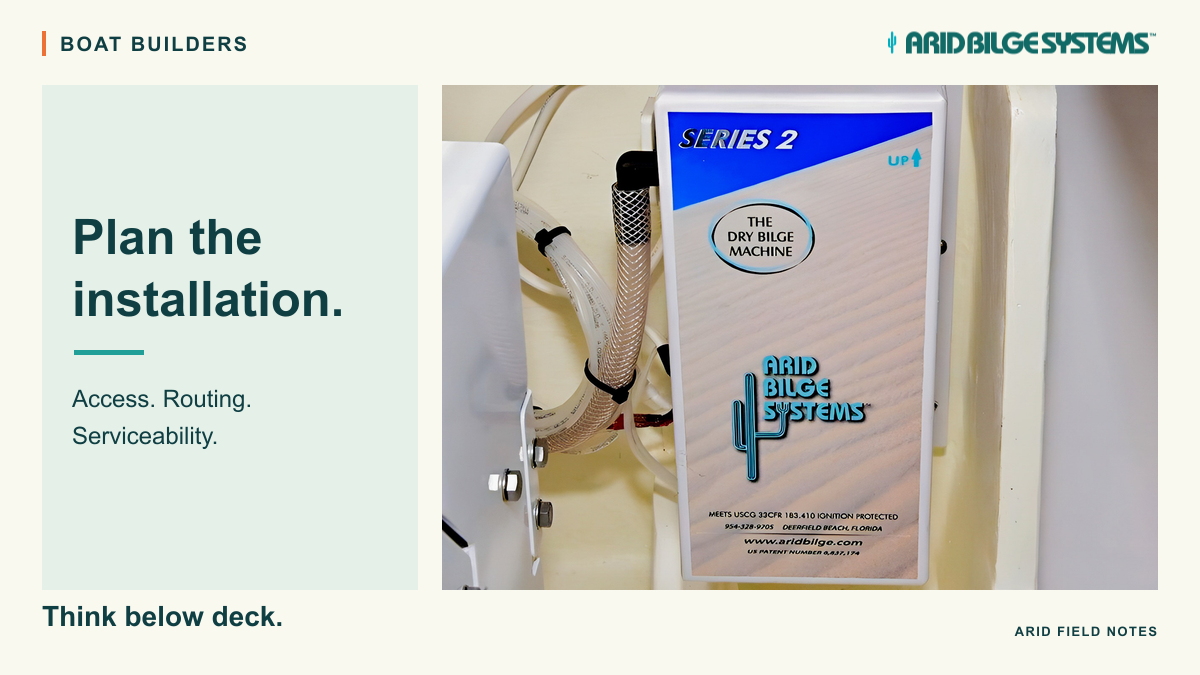
- Mounting locations can be selected before access becomes restricted
- Discharge routing can be engineered into the vessel
- The installation can be tested before delivery
A properly planned discharge arrangement may also provide a cleaner and more direct installation than a later retrofit.
The exact discharge method should always be designed for the specific vessel and completed in accordance with applicable marine standards, engineering requirements, and manufacturer instructions.
Factory installation also gives the builder an opportunity to place pickups at the actual low points of the vessel rather than working around finished interiors and restricted service access later.
A Centralized Approach to Residual-Water Management
Traditional emergency bilge pumps remain essential safety equipment. They are designed to move larger volumes of water during leaks, equipment failures, or other emergencies.
An Arid Bilge System performs a different job.
It automatically removes the smaller amounts of residual water that conventional pumps leave behind. Multiple pickup zones can be managed from one centralized system, helping keep the bow, machinery spaces, midship compartments, and stern drier between emergency-pump activations.
This can provide:
- Centralized residual-water removal
- Cleaner machinery spaces
- Easier identification of new leaks
- Reduced standing water
- Less standing water available to evaporate
- Fewer odor-producing wet areas
- Better visibility during inspections and service
The purpose is not to replace required emergency pumping equipment. It is to manage the moisture that remains after those systems have done their job.
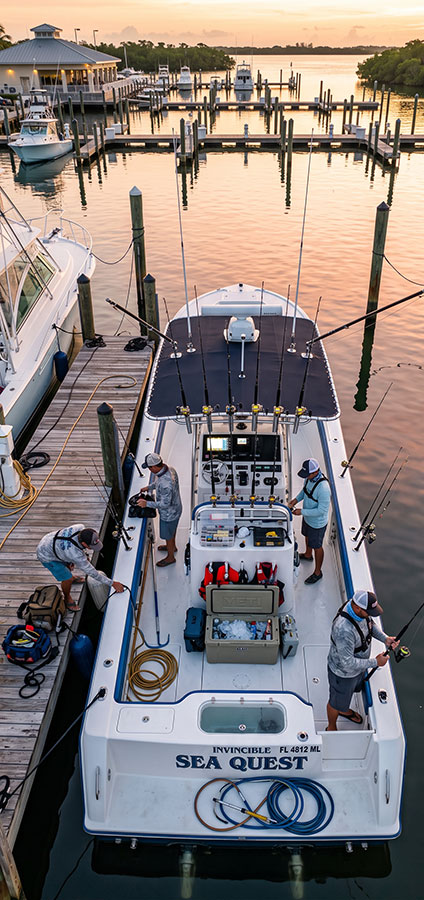
Remove the residual water. Reduce one moisture source.
Low-profile pickups connect selected low points to the Arid unit through small tubing. Arid collects the remaining liquid and transfers it to the vessel's designed discharge arrangement. Removing that water leaves less available to evaporate and makes newly returning water easier to see during inspection.

Inside the system: air does the moving.
The compressor moves air, while the collection chamber handles the bilge fluid. Vacuum draws liquid into that chamber; air pressure then pushes the collected liquid through the discharge line. The diagram below shows this repeating collection cycle.

1. Build vacuum
The compressor removes air from the collection chamber, creating the pressure difference used for collection.
2. Collect liquid
The selected intake opens. Stored vacuum draws residual water through the pickup and tubing into the chamber.
3. Discharge
Air pressure pushes collected liquid through the discharge path. The cycle repeats automatically.
Why this design matters over the years
Moving bilge liquid in a collection chamber keeps the fluid-handling path separate from the compressor's air-moving role. That is the design principle behind Arid's approach to long-term bilge care. It does not make the system maintenance-free: pickups, tubing, connections and the system still need model-specific checks and care.
Service life depends on installation, usage, operating conditions and maintenance. The air-driven mechanism alone does not establish a fixed lifespan, guaranteed component life or a financial payback period. A reachable installation and a clear owner handover support continued care.
Arid complements conventional and emergency bilge pumps. Keep those pumps operational for their own duties. Explore how Arid works and how pickups are installed.
The Financial Case for Boat Builders
For a builder, the value is not limited to the cost of the equipment.
The larger consideration is whether a relatively small factory-installed system can help reduce exposure involving:
- Electrical diagnostics
- Corroded wiring and terminals
- Moisture-damaged brackets and fasteners
- Generator service
- Thruster-related repairs
- Gyro or stabilizer concerns
- Repeat odor and dampness complaints
- Dealer labor and customer-relations costs
Compare vessel-specific service quotations with the complete installed cost of the system. Whether any particular repair could be avoided requires evidence about the failure and its cause.
That does not mean every future repair will be prevented. It means the builder can reduce one persistent environmental risk: residual water remaining below deck.
What could moisture cost a builder?
A service visit can involve diagnosis, access, parts, labor and a return visit. The builder's share depends on the actual fault and coverage, supplier recoveries and the work performed. An owner may face inconvenience and maintenance expense; a dealer may spend time tracing recurring wet areas and supporting the customer.
Avoiding a genuinely moisture-related service event could have value. To call that a saving, however, the avoided expense must be attributable to residual-water management and exceed the system's purchase, installation and upkeep costs. These illustrations show how to frame that question.
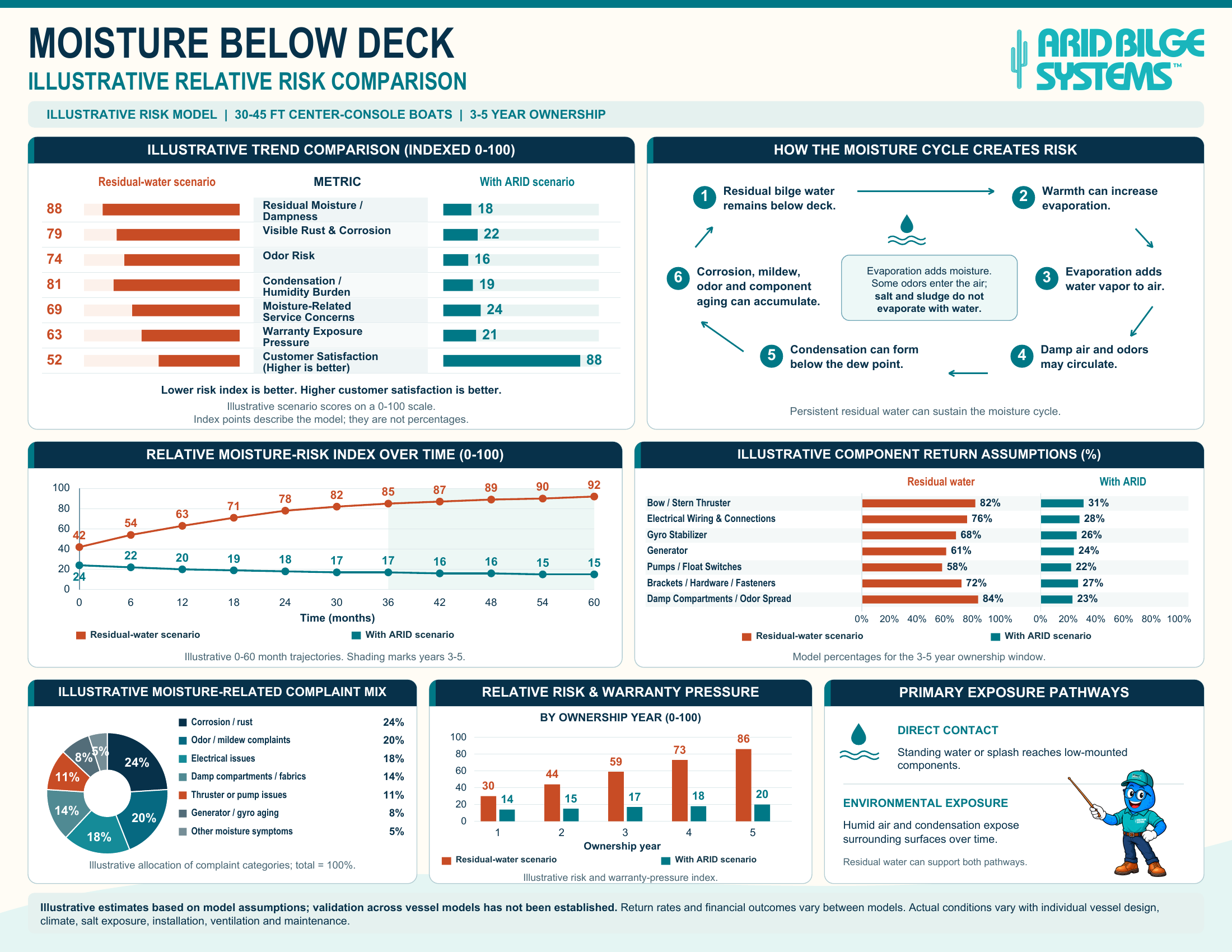
The supplied models assume 30–45 ft center-console boats over 3–5 years. Their precise scores, percentages, event counts and dollar inputs remain unverified. They do not establish actual warranty reductions, expected savings, service life or financial returns.
Moisture and component exposure
Service costs and the ownership calculation
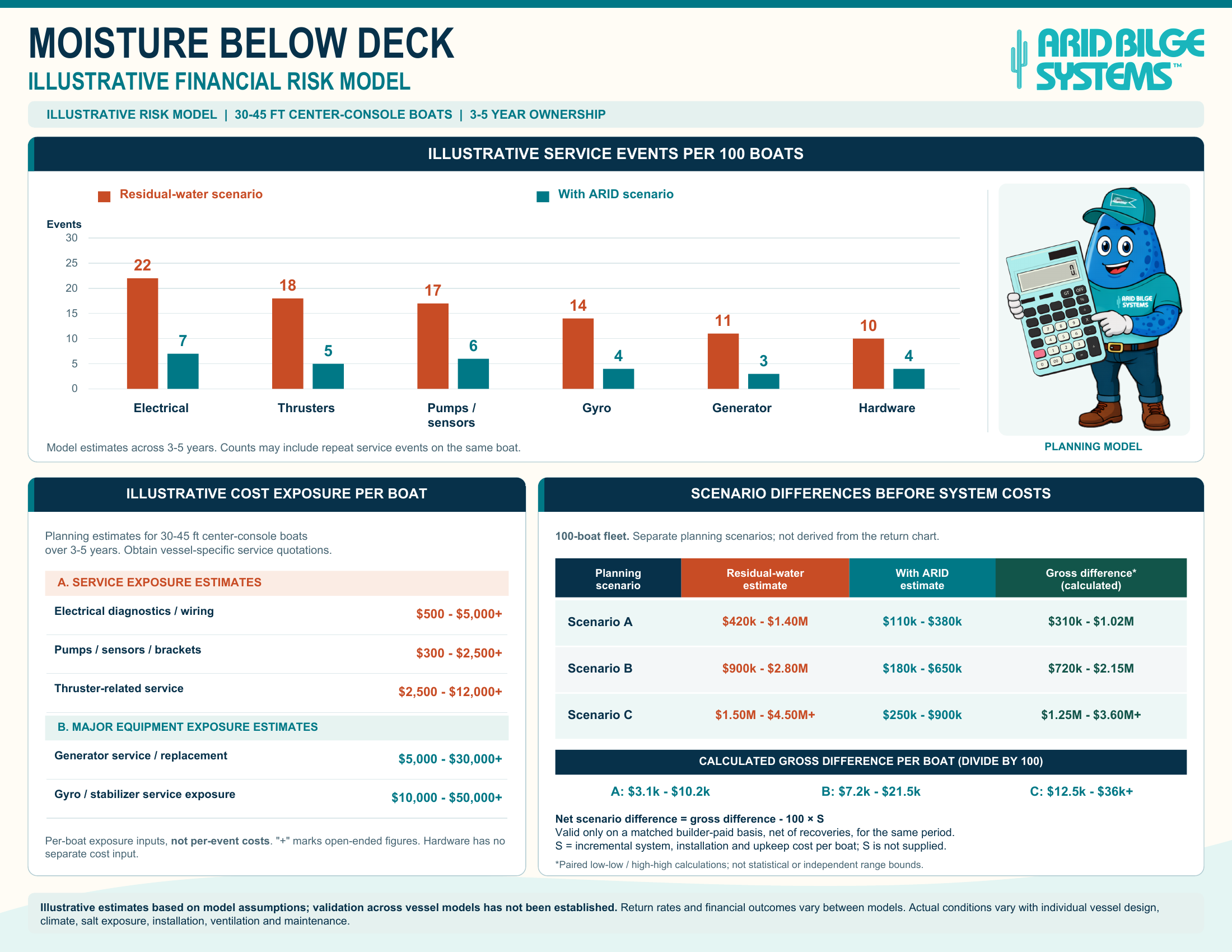
The financial sheet compares separate hypothetical 100-boat scenarios. Its gross differences are calculated before paying for the systems, installation and upkeep. The service-event chart and cost-exposure panel are separate assumptions; they do not generate those fleet totals.
Gross difference is only the starting point.
For example, Scenario A pairs $420,000 with $110,000 at its low end: a $310,000 gross difference across 100 boats, or $3,100 per boat. That is arithmetic on assumed inputs, not $3,100 of proven savings.
Net scenario difference = gross difference − 100 × S
S is the incremental system, installation and upkeep cost per boat over the same period. S has not been supplied. The gross comparison must also use the same builder-paid basis, net of recoveries. Without those inputs and attributable service evidence, net savings and payback remain unknown.
Read the model assumptions and calculation limits
The risk model uses 30–45 ft center-console boats and a 3–5-year ownership window. Its time curve spans 0–60 months. The 0–100 indices, complaint allocation and component-return percentages are supplied estimates. No measured dataset, sample size or reproducible empirical method validating these exact values has been established.
Financial service counts are events per 100 boats, including possible repeat events. Per-boat cost exposures are not per-event repair costs. Hardware has no separate cost input. The 100-boat scenarios are separate planning estimates and must not be reconstructed by multiplying the event counts by the exposure ranges.
The calculated gross differences are A: $310,000–$1.02 million; B: $720,000–$2.15 million; and C: $1.25 million–$3.60 million+. Dividing each by 100 gives $3,100–$10,200; $7,200–$21,500; and $12,500–$36,000+ per boat, before system costs. Low endpoints are paired with low endpoints and high with high; these are not statistical or independent range bounds. A plus sign marks an open-ended estimate.
Actual conditions vary with vessel design, climate, salt exposure, installation, ventilation, maintenance and use. A builder should replace the assumed figures with diagnosed service events, attributable costs and actual system expenses. Allocated overhead and fixed salaries are not automatically avoidable cash costs. Owner, dealer and builder costs must be kept separate so the same expense is not counted twice.
Build a business case from your own boats.
Record the wet area, diagnosis, work performed, parts and labor, time in service and who paid. Compare similar vessels over the same period, and record other changes such as ventilation or equipment updates. This helps distinguish a useful installation improvement from an unsupported claim that every future repair will disappear.
For an owner or dealer, the practical value starts with more manageable low points and easier inspections. Any longer-term financial benefit must follow actual experience. Discuss your vessel layout and a builder installation with Arid.
What It Means for the Dealer
Dealers benefit when the boat is easier to maintain and explain to the owner.
A dry below-deck environment can mean:
- Fewer odor complaints
- Easier leak identification
- Cleaner service access
- Less time investigating recurring dampness
- A stronger long-term ownership experience
- Another visible point of differentiation during the sales process
Dealers are also in a strong position to report recurring moisture patterns back to the builder. That feedback can help refine pickup locations, installation practices, and future vessel designs.
What It Means for the Owner
The owner receives a boat designed not only for delivery day, but for the years that follow.
Continuous residual-water management can help provide:
- A fresher vessel
- Cleaner machinery spaces
- Better protection for surrounding equipment
- Easier maintenance and inspection
- Earlier visibility of developing leaks
- Improved long-term presentation and resale confidence
A factory-installed dry bilge system should not be positioned merely as a comfort feature. It is part of a broader strategy for controlling the environment below deck.
Protecting the Boat Beyond the Warranty Period
A well-built boat represents its manufacturer long after the original warranty ends.
Owners remember whether the vessel remained clean, dependable, and easy to maintain. Dealers remember whether they repeatedly addressed odor, corrosion, dampness, and difficult-to-diagnose electrical problems.
Managing residual water from the beginning helps the vessel represent the builder’s standards in year eight—not only in year one.
Next Step
Arid Bilge Systems works with boat builders and dealers to review vessel layouts, determine wet-zone counts, recommend pickup locations, and develop factory-installation plans.
A proper evaluation should consider:
- Vessel size and compartment layout
- Number of wet zones
- Pickup placement
- System voltage
- Tubing distances
- Mounting location
- Discharge design
- Production and service access
To discuss factory installation, OEM integration, or a dealer relationship, contact Arid Bilge Systems.