
Most boat owners think of bilge water as a nuisance.
A little water settles below deck, the bilge pump kicks on when it has to, and life goes on.
But that small amount of standing water can create a much bigger problem than most people realize.
What gets left behind in the bilge does not just sit there harmlessly. Over time, trapped bilge water creates humidity, spreads odor, accelerates corrosion, and slowly contributes to hidden damage throughout the boat. The process is gradual, which is exactly why it is so often overlooked.
By the time the signs become obvious, the damage may already be well underway.
The Problem Starts with Residual Water
It may not look like much, but that leftover water becomes the starting point for a chain reaction.
Heat Turns Standing Water into a Hidden Moisture Problem
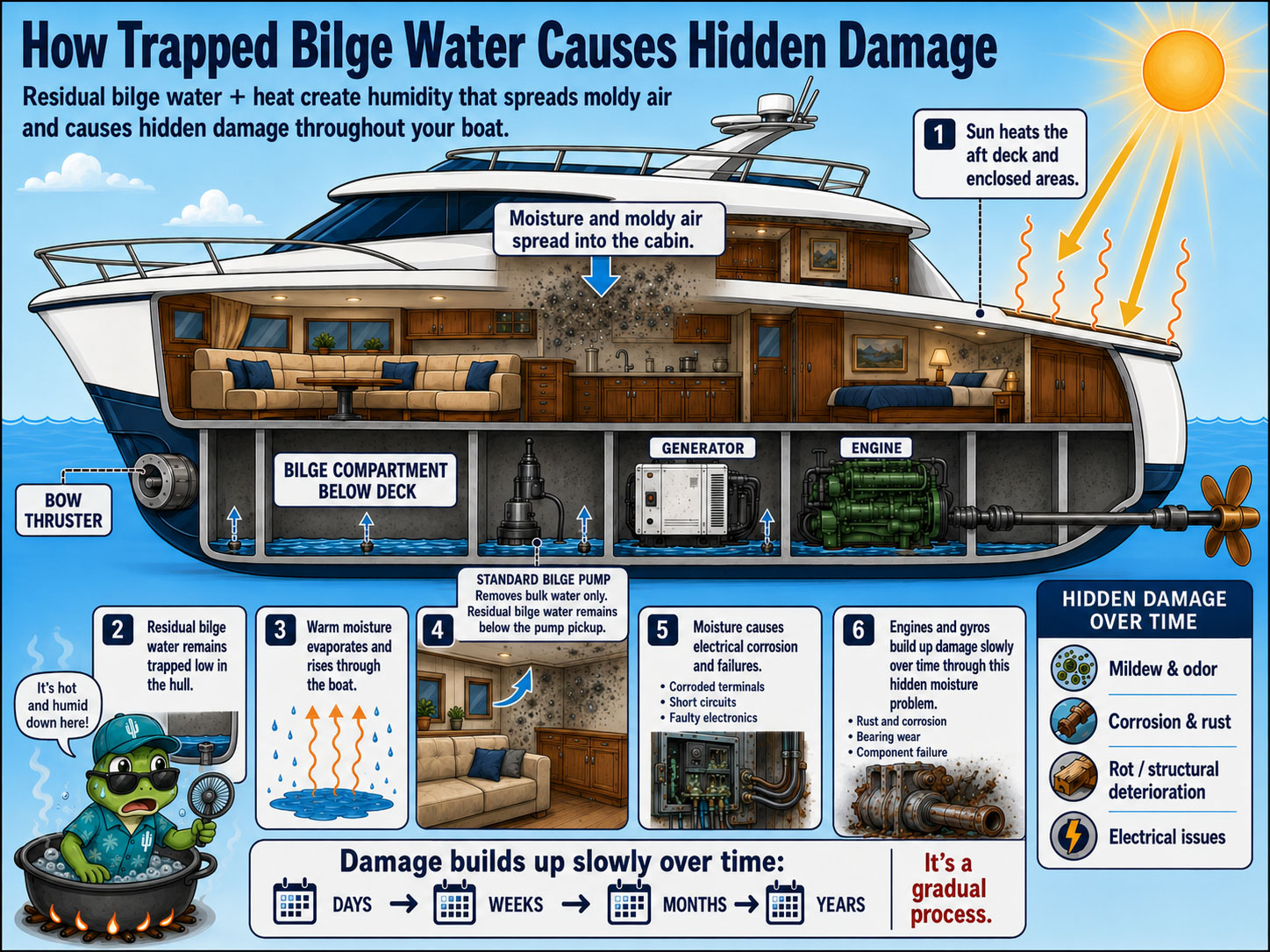
When the sun heats the deck and enclosed spaces of a boat, the temperature below deck rises.
That heat affects the standing bilge water trapped low in the hull. As the water warms, moisture begins to evaporate and rise upward through the vessel. The result is damp air moving from the bilge into surrounding compartments and living spaces.
This is where the real problem begins.
The issue is not just the water itself. It is the humid environment that the water creates.
- Cabin spaces
- Upholstery and soft goods
- Wood cabinetry and interior finishes
- Electrical compartments
- Engine and machinery spaces
- Storage areas
- Wiring, terminals, and fittings
Why Standing Bilge Water Creates Odor
One of the first signs of trapped bilge water is odor.
When moisture remains below deck, it creates an environment where stagnant smells build up. Residual bilge water may contain traces of salt, dirt, oil residue, organic material, and other contaminants. As that mixture sits in a warm enclosed compartment, it creates the musty, sour, moldy smell many boat owners know too well.
The odor does not stay isolated to the bilge.
As humid air rises, it carries that smell upward into the rest of the boat. That is why a boat can smell damp or stale even when the cabin itself appears clean.
Owners often try to fight this with air fresheners, deodorizers, or cleaning products. But those only treat the symptom. They do not remove the source.
If the residual water remains, the odor usually comes back.
Moisture Leads to Corrosion Below Deck
Standing bilge water does more than create odor. It also creates a moisture-rich environment that can speed up corrosion.
Marine environments are already hard on equipment. Add damp air and lingering moisture, and metal components are under even more stress.
Over time, that can affect:
- Hose clamps
- Fasteners
- Pump hardware
- Electrical terminals
- Wiring connections
- Steering and mechanical components
- Engine and generator spaces
- Brackets, fittings, and hardware
This kind of corrosion often develops slowly. A boat may still look fine at a glance, while hidden moisture is quietly wearing away at key components below deck.
That is part of what makes the problem expensive. The damage builds gradually, often out of sight, until a service issue appears or a component fails earlier than expected.
Hidden Moisture Can Affect Electrical Systems
Electrical systems do not respond well to damp environments.
Moisture below deck can contribute to corrosion on terminals, compromised wiring connections, short circuits, and unreliable electronics. The problem is not always dramatic at first. Sometimes it shows up as intermittent issues, unexplained faults, or equipment that simply does not last as long as it should.
Because the bilge is below so many critical systems, persistent humidity can affect much more than most owners expect.
A wet bilge does not just threaten cleanliness. It can quietly undermine reliability.
Engines, Machinery, and Equipment All Feel the Effects
The hidden damage from standing bilge water is not limited to odor or cabin comfort.
Engine rooms, machinery compartments, pumps, generators, and related equipment all operate better in a clean, dry environment. When damp air and humidity remain present over long periods, they can contribute to corrosion, wear, residue buildup, and shortened component life.
Again, this is rarely a sudden event.
It is a slow process measured over days, weeks, months, and years.
That is why many owners do not connect the problem back to the bilge. By the time corrosion, odor, mildew, or electrical issues appear, the trapped water that started the cycle has often been there a long time.
Damage Builds Slowly Over Time
One reason standing bilge water is underestimated is that the damage is gradual.
It usually follows a pattern like this:
Days:
Residual water remains trapped in the bilge.
Weeks:
Humidity and odor begin to build below deck.
Months:
Corrosion, mildew conditions, and moisture-related wear increase.
Years:
Hidden damage becomes visible through equipment issues, rust, odor, material deterioration, and declining overall condition.
Because this process is slow, it is easy for owners to normalize it. A little smell, a little rust, a little moisture, a little staining. But those are often signs of a deeper problem that has been developing over time.
Why Bilge Pumps Alone Are Not Enough
A bilge pump is essential safety equipment, but it was never meant to keep the boat completely dry.
Its job is to move bulk water out when needed. It activates at a certain level and shuts off once that level drops. That means it often leaves water behind at the bottom of the bilge.
This is the difference between removing water in an emergency and managing residual water for long-term boat protection.
That second job is where a dry bilge system becomes valuable.
How Arid Bilge Systems Stops the Problem at the Source
Arid Bilge Systems approaches the problem differently.
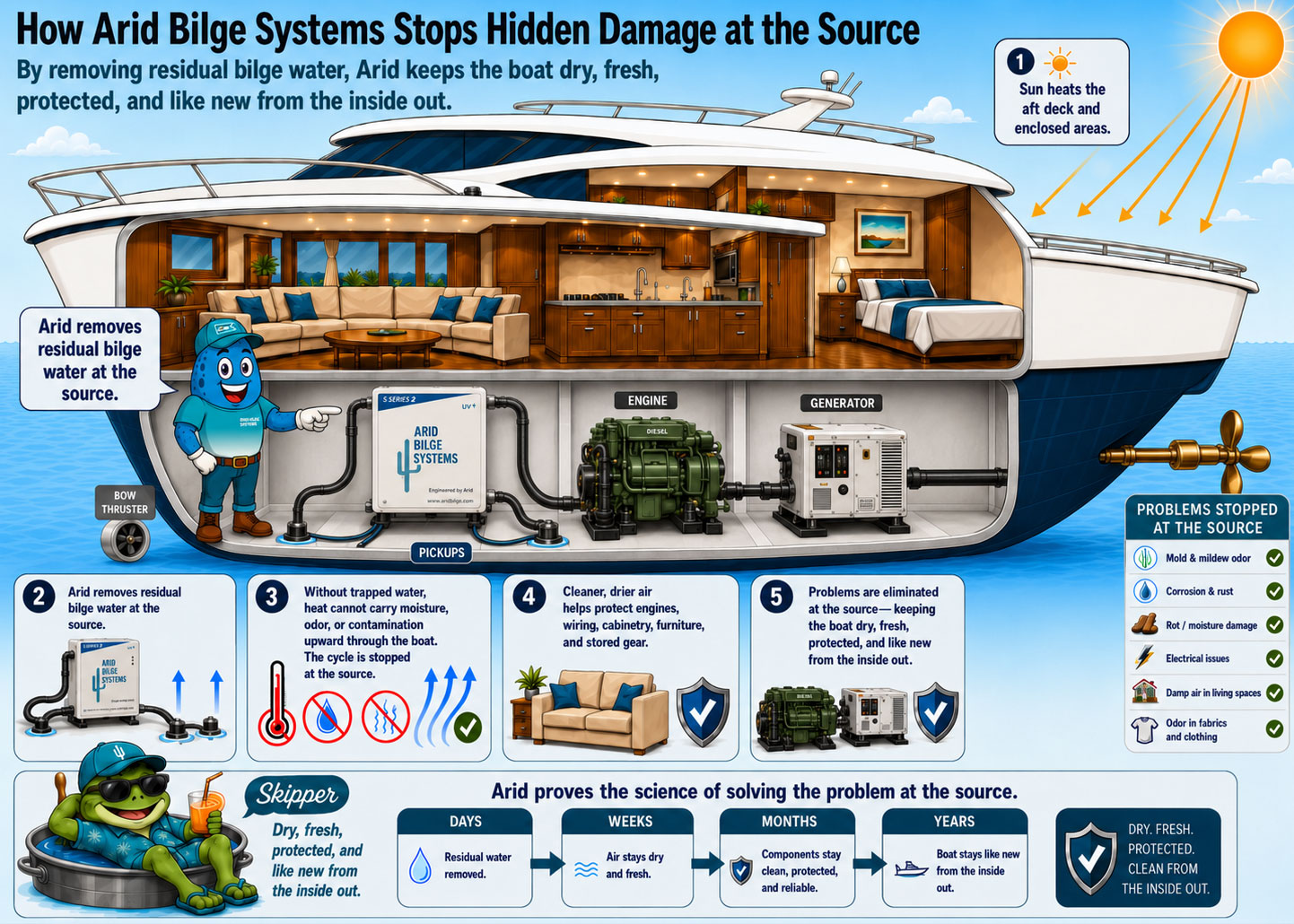
Instead of waiting for water to rise high enough to trigger a pump, Arid removes residual bilge water directly from the low points where it collects. By removing that standing water at the source, the system helps stop the cycle before humidity, odor, and hidden damage spread through the boat.
That means:
- Less trapped moisture below deck
- Reduced odor and mildew conditions
- A drier environment around engines and equipment
- Better protection for electrical and mechanical components
- A cleaner, fresher bilge
- A boat that stays drier from the inside out
The goal is simple: do not just move bulk water—eliminate the standing residual water that causes the long-term problem in the first place.
A Dry Bilge Protects the Entire Boat
The value of a dry bilge reaches far beyond the bilge compartment itself.
When the source of the moisture is removed, the rest of the boat benefits. The cabin stays fresher. The air stays drier. Compartments stay cleaner. Machinery is surrounded by a better environment. Corrosion risks are reduced. Hidden spaces become easier to inspect and maintain.
- That is why a dry bilge system is not just a convenience feature.
- It is a long-term protection system.
Final Takeaway
Standing bilge water does far more than make the bottom of a boat wet.
It creates odor, increases humidity, spreads damp air, accelerates corrosion, and contributes to hidden damage that builds slowly over time. Traditional bilge pumps are important, but they typically remove only the bulk water—not the residual water left behind at the true low points of the hull.
That residual water is where the trouble starts.
By removing it at the source, Arid Bilge Systems helps stop the cycle before it turns into odor, corrosion, moisture damage, and costly long-term deterioration.
Dry. Fresh. Protected.
That is what happens when the problem is solved at the source.