
Wooden boat care starts below deck
We first met Jim Moores through the boat-show community and have known him for many years. He became a longtime personal friend as well as someone whose experience with wooden yachts we value. His story aboard Aurora II brings that experience down to a problem many owners recognize: water collecting out of sight beneath an otherwise beautiful boat.
A lifetime spent caring for classic wooden yachts
Jim founded Moores Marine in 1986, specializing in the restoration and repair of antique and classic wooden boats. His earlier work in Maine included commercial fishing vessels. The company’s restoration history includes Trumpy yachts, the presidential yacht Honey Fitz, and the schooner Summerwind. These are boats whose continued life depends on skilled work inside the hull as much as on the finish above deck.
Aurora II: a 1947 Trumpy and a recurring moisture problem
For wooden boats, lingering bilge water is a maintenance concern as well as a source of musty smells. In this testimonial, restoration specialist Jim Moores describes the mildew he found aboard his 1947 Trumpy, Aurora II, and the changes he noticed after installing an Arid Bilge System.
For a short overview, watch Why Dry Bilges Matter on Wooden Boats | Jim Moores.
Jim Moores’ Account of Aurora II
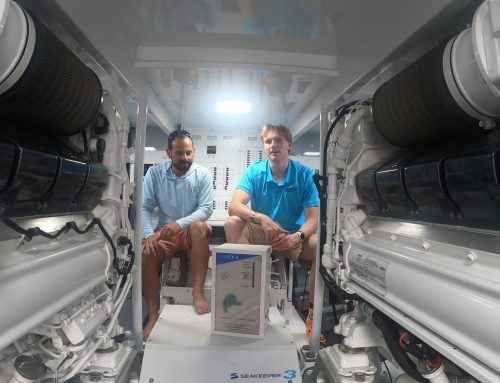
In the video, Jim explains what he found, what he cleaned and what changed once the system was working aboard his boat.
Jim recalls buying the boat in Florida and finding mildew throughout the interior. He discarded mattresses, cleaned the affected spaces and later repainted the ceiling. He also installed an Arid Bilge System to remove the small amounts of water that continued to collect below deck.
He reports a fresher-smelling interior after that work. During a later electrical interruption, he noticed the smell returning and checked the system. In the video, he shows an enclosed area where visible growth had appeared and explains how little ventilation the compartment had.
His experience connects three separate jobs: cleaning existing contamination, restoring affected finishes and managing recurring water. The water-removal system was one part of that work. His account is specific to Aurora II; it does not establish that removing bilge water alone eliminates mildew or produces a health benefit.
How persistent bilge moisture can damage wood from inside
A wooden yacht can look well cared for on deck while concealed timber stays wet below. Where repeated wetting, oxygen and suitable temperatures support decay fungi, the fungi consume parts of the wood and reduce its strength. The USDA Forest Products Laboratory’s Wood Handbook explains these conditions. Mold on a surface and structural decay are different problems; appearance or smell alone cannot establish how sound a timber remains.
Look beyond the central puddle. Joints, low pockets and enclosed spaces can remain damp after the easily reached water is removed. The maintenance goal is to shorten that repeated wetting, preserve access and investigate changes early. On a traditional wooden hull, a boatwright should guide the care of planking and seams; managing standing bilge water does not mean trying to dry the entire hull indiscriminately.
Jim’s experience illustrates why water removal belongs alongside ventilation, cleaning and repairs. It also connects with Barry Delk’s wooden Gillikin sportfisher, Longer Hours, where Arid personally installed a Series 4×8 in 2008 and the system is still running about 18 years later.
A practical starting point for wooden boats
Begin with an inspection of the spaces you can reach. Record standing water, staining and changes in odor. Then work through the causes and the access needed to maintain those areas:
- Identify where water enters and where air-conditioning condensate collects.
- Have timber, coatings and ventilation assessed as part of the maintenance plan.
- Clean existing contamination using guidance appropriate to the materials and condition.
- Discuss pickup placement and service access with an installer familiar with the vessel.
A drier baseline can make a new wet patch easier to notice. It does not repair damaged timber or remove the need to investigate a leak. Follow up on changes rather than relying on a fresh smell as proof that every compartment is sound.
Keep the Roles Clear
Arid removes residual water from connected pickup locations. Conventional bilge pumps remain in place for higher-volume pumping. Our wet-zone guide can help organize the inspection before discussing a system.
Watch Jim’s full video for his firsthand account aboard Aurora II.