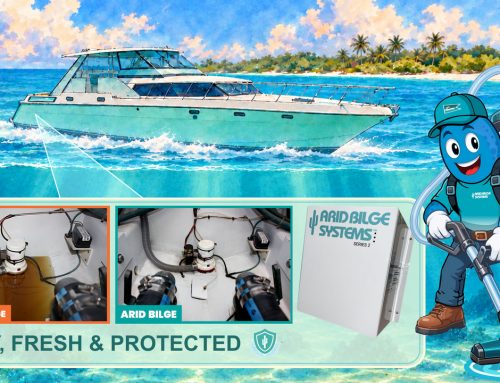

At Bahama Boat Works, the discussion of fit and finish extends into the bilge. Bob Sparks, Derek Rawnsley and Connor Henley explain that connection in this conversation with Alfred Baurley.
Sparks and Rawnsley focus on the condition owners see when they open a hatch. Henley discusses the company’s history, its approach to limited production and the equipment installed in those below-deck spaces. His recommendation for Arid is part of that wider discussion about moisture and routine care.
Watch the short version of why Bahama chooses Arid, or continue with the complete video and edited highlights.
Edited highlights from Bahama Boat Works
The following summary brings together the main points from the video. Watch the complete conversation above for the speakers’ own words.
Fit and finish continues below deck
Sparks and Rawnsley describe the bilge as part of the finished boat an owner sees. Opening a hatch should reveal a space that reflects the care taken elsewhere aboard. Their comments connect Arid’s residual-water collection with that expectation of a neat, clean compartment.
The equipment sharing the space matters, too. They discuss the electronics and other components installed below deck, and why the condition of the surrounding bilge deserves attention.
How Bahama Boat Works handles owner choices
Henley places that discussion in the context of Bahama’s approach to building boats. He describes a family-owned business with limited production and an emphasis on fit and finish. He also talks about the practical knowledge involved in working inside a boat’s equipment compartments.
In the discussion of component choices, he explains that Bahama has preferences while also working with customers on their requirements. Electronics and other onboard systems are part of that conversation. The point is to consider how the finished boat will be used and cared for, alongside the equipment specified during the build.
Consider the space around the equipment
Henley recommends Arid in the context of moisture that can collect in enclosed bilge areas. His examples include the combination of water, heat and closed hatches in a marine environment. The concern is the condition an owner finds when that space is opened again.
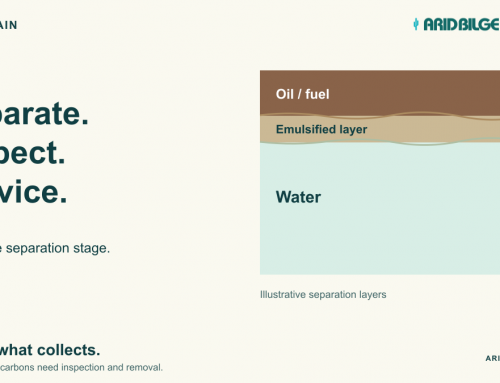
That makes bilge care part of the equipment discussion. Residual-water collection, access for inspection and continued maintenance all belong in the plan. The interview describes Bahama’s perspective and experience; the appropriate installation still depends on the individual boat.
Read more about Bahama Boat Works on their website.
See the water-routing animation
This silent animation shows pickups in separate low areas connected by tubing to a central Arid unit, with collected water moving through a discharge line.
Include the bilge in the equipment conversation
Henley’s comments bring the focus back to the space around the equipment. When considering a boat’s layout, look at where water can collect and how those areas can be inspected and maintained. Read how Arid collects residual bilge fluid for the process behind that part of the installation.