
Dry bilge system cost depends on the work needed to serve your boat’s wet areas. Equipment price is one part of that estimate. Access, mounting, tubing, electrical connections, discharge routing and installation labor also matter.
Start by defining the job. Replacing a failed conventional bilge pump is a different project from removing shallow water left in separate compartments. Arid automatically collects residual fluid from installed pickups; it complements the boat’s conventional pumps and alarms.
Replacing a pump versus adding a new installation
A replacement pump may use an existing mounting position, wiring and discharge route, provided those remain suitable and serviceable. Adding equipment to another compartment can require new access, plumbing and electrical work.
Ask the installer to identify which parts can be reused and which need attention. An estimate based only on the new pump’s retail price leaves those questions unanswered.
What belongs in a dry bilge system estimate?
Compare options that address the same residual-water locations. Request an itemized estimate covering:
- Wet areas: the separate low points to be served and the planned pickup positions.
- Equipment: the selected model, pickups, tubing, fittings and controls.
- Access and mounting: any panels, brackets or other work needed to install and service the equipment.
- Electrical work: the correct supply, circuit protection and accessible means of switching the system off.
- Fluid routing: the collection or discharge arrangement and any additional treatment equipment.
- Labor and commissioning: installation, testing each pickup location, labeling and owner handover.
- Additional vessel work: any haul-out or through-hull work the proposed installation actually requires.
Whether a suitable existing discharge route can be used depends on the vessel. Have the installer confirm that route before assuming that new hull fittings—or a haul-out—can be avoided.
Count locations before choosing equipment
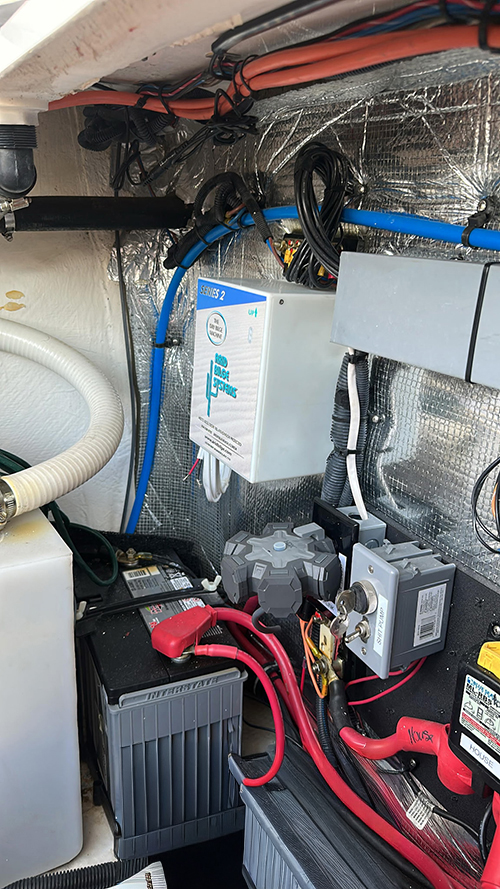
Depending on the model, an Arid unit serves one or several pickup locations. Separate pockets of water may need separate pickups even when they are close together. Boat length alone does not establish that count.
A multi-zone installation brings several intake routes back to a central unit. That can change the amount and location of plumbing and equipment compared with separate residual-water removal devices. The useful comparison is the complete proposed installation on your boat.
Read how the Arid system works, then use the wet-zone guide to prepare a list. Photographs of each low point and its access opening make an installer’s assessment more useful.
Include the maintenance you will actually do
Keep enough access to inspect pickups, tubing and the central unit after installation. Ask who will clean the pickup areas, investigate changes in operation and perform any model-specific seasonal service.
A normally dry compartment can make new water easier to notice. Removing residual water does not repair a leak, remove existing contamination or guarantee a particular reduction in repair costs. Treat those conditions as maintenance questions to investigate, rather than assumed financial savings.
Bring the same brief to each installer
Provide the wet-zone list, boat layout, supply voltage, mounting-space measurements and photographs. Ask each installer to state the equipment and work included, the exclusions and how the finished system will be tested.
Our installation preparation guide explains what to gather. An Arid dealer can then discuss a configuration for those locations.
Common cost questions
Can Arid replace a failed conventional bilge pump?
No. Restore the boat’s required pumping and alarm equipment. Consider residual-water removal as a separate job, and investigate the source of unexpected incoming water.
Does every installation need a new through-hull?
That depends on the boat and the proposed routing. Have the installer assess the existing arrangements and identify any changes in the estimate.
Is there one reliable installed price for every boat?
No. Wet-zone count, access, selected equipment and the required vessel work vary. An itemized quote for the actual boat is more useful than an unsupported average.