
The Right Pickup is Key
Most of the attention in a dry bilge installation goes to the unit mounted on the bulkhead. But the part that actually decides whether your bilge gets dry is much smaller and sits at the other end of the tubing.
The pickup is the first point of contact between the wet area and the system. It is also one of the easiest parts of the installation to get wrong.
A dry bilge system can only remove water that reaches the pickup. Choose the wrong pickup style, or place the right pickup in the wrong location, and a zone may never fully clear no matter how well the unit runs.
Why One Pickup Style Is Not Enough
Residual water may settle in a flat bilge area, run along a V-shaped channel, pool in an air-conditioning drip pan, sit in a shower sump, gather in a low spot, or hide in a deep pocket that cannot be reached by hand.
That is why Arid offers multiple pickup styles instead of one universal pickup. Each pickup is designed to reach a specific kind of wet area. The right choice depends on the shape of the compartment, the space available, and where gravity actually sends the fluid.
The Four Pickup Options
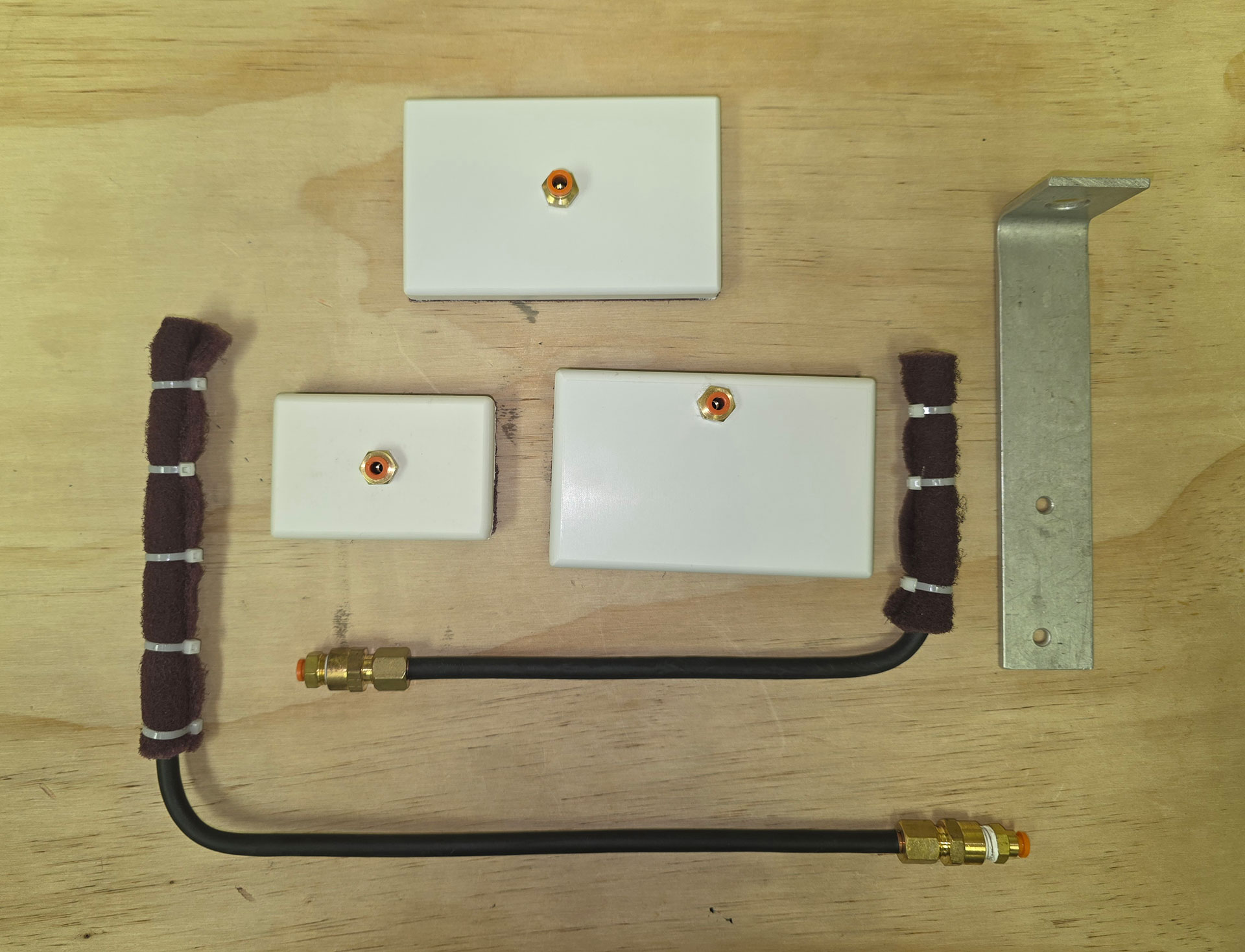
| Pickup | Size | Best for | System match |
|---|---|---|---|
| Mini | 2 x 3 in | Compact flat bilge areas, large AC drip pans, smaller compartments, tight spaces | All systems |
| Standard | 2.7 x 4.5 in | Larger vessels with flat bilge areas or wider collection points | Series 4 and 9 only |
| Offset | 2.7 x 4.5 in | V-bottom bilges, bow areas, twin-V engine bilges, linear groove compartments | All systems |
| Flexible wand | Small and large | Narrow, deep, or awkward spaces, limber holes, deep pockets, AC drip pans | Small wand for Series 1 and 2; large for Series 4 and 9 |
Mini Pickup
The Mini Pickup is a compact flat pickup with an H-groove channel that allows fluid to settle evenly for efficient collection.
It is commonly used forward or aft of bilge pumps, inside AC drip pans, in smaller compartments, and in flat bilge areas where water collects.
The Mini Pickup is often the right choice when space is limited but the installation still needs a stable flat pickup.
Standard Pickup
The Standard Pickup uses the same general concept as the Mini Pickup, but with a larger footprint for broader surface coverage. It should be positioned at the lowest practical point where fluid settles on a flat surface.
There is an important system-matching limit: the Standard Pickup is offered for Series 4 and Series 9 systems only.
Its larger footprint and larger H-groove area require more vacuum reserve to pull fluid efficiently across the full underside of the pickup. Series 1 and Series 2 collection chambers have less vacuum reserve, so a larger pickup can draw air back too quickly. When that happens, the system may read the zone as clear too soon and leave a small amount of fluid beneath the pickup.
For Series 1 and Series 2 systems, the Mini Pickup is the correct match.
Offset Pickup
The Offset Pickup is built for V-style and angled bilge compartments where fluid collects along a groove, channel, or lower edge.
It is commonly used in V-bottom bilges, forward bow areas, twin-V engine bilges, and other compartments where water follows the shape of the hull.
Exact placement depends on the hull design and the structural bilge layout. In many boats, water collects toward the aft end of each bilge location unless the compartment is uneven or shaped differently.
Flexible Pickup Wand
The Flexible Pickup Wand is designed for narrow, deep, or awkward spaces where a flat pickup cannot sit properly.
The wand can be adjusted to reach confined areas, making it useful for AC drip pans, limber holes, deep bilge pockets, and unusual bilge layouts.
The wand comes in smaller and larger configurations. The difference is not cosmetic. The smaller wand uses fewer intake holes, while the larger wand uses more intake holes to support higher-capacity systems.
Pickup size and intake-hole pattern must match the vacuum reserve and cycling behavior of the system. This is the same reason the Standard Pickup is limited to larger systems.
Placement Beats Selection
The best pickup in the wrong location will not dry the bilge.
A pickup needs to sit at the lowest practical point of accumulation, where gravity naturally brings the water.
A common mistake is placing the pickup near a bilge pump and assuming the zone will clear. Sometimes that works. Often it does not, because the bilge pump is not always located at the lowest or deepest point.
The correct pickup location is wherever residual fluid remains after the boat settles into its normal floating position.
When walking the boat, look for:
- The lowest points where fluid naturally settles
- Flat pockets that hold water after the bilge pump shuts off
- Hidden compartments that may be sealed off with no builder hatch
- AC drip pans and shower sumps
- Limber holes and deep pockets
- Compartments beneath machinery or equipment
- Areas that are difficult to reach by hand
Do Not Drill the Pickup
Do not drill into the pickup.
Drilling into a pickup can damage the pickup body, screen, filter area, and internal flow path. It can also create a path for dirt, fiberglass dust, bilge contamination, and shavings from the drilling itself to be pulled directly into the vacuum intake line.
Once the system cycles, that material can travel into the tubing and eventually into the unit, where it may restrict flow, reduce vacuum performance, or clog the intake valve.
The pickup is designed to collect fluid through its grooves, screen, filter, and flow path. It should not be modified with drills, cuts, or fasteners through the pickup body.
Do Not Over-Clamp the Pickup
Installers often ask whether the pickup should be clamped down hard. In most cases, the answer is no.
The pickup needs to breathe. Fluid and air must be able to enter freely for the system to complete its cycle. If the pickup is squeezed too tightly, the grooves or intake area can become restricted. When that happens, the zone may not clear properly and water may remain in the bilge.
Over-clamping can cause:
- Restricted fluid entry
- Reduced vacuum efficiency
- Incomplete zone clearing
- False dry-zone behavior
- Long-term debris restriction
The Right Way to Secure the Pickup
The preferred way to secure a pickup is often through the intake tubing itself.
Route the tubing so it places slight downward tension on the pickup. Between the pickup’s weight, its center of gravity, built-in friction, and gentle tubing tension, the pickup usually stays where it is placed.
There is a simple demonstration that helps explain this. Set a pickup in your palm with a short piece of tubing attached. Apply slight downward pressure through the tubing, then turn your hand upside down. The pickup stays in place without needing heavy clamping.
If more support is needed, use a bracket that holds the pickup fitting without compressing the pickup body.
Next Step
Once the pickups are placed correctly, keeping them clean is the main routine maintenance step the system requires.
Pickup maintenance helps protect vacuum performance, prevent intake restrictions, and keep each zone clearing properly over time.
Our pickup maintenance guide covers the recommended schedule and what to watch for.
Frequently Asked Questions
Which pickup should I use in a V-shaped bilge?
Can I use a Standard Pickup on a Series 1 or Series 2?
For Series 1 and Series 2 systems, the Mini Pickup is the correct match.
Not automatically.